
Work From Home? Workers’ Comp Might Still Cover You
Remote Jobs Can Still Lead to Work-Related Injuries, and Many People Don't Realize the Rules May Apply in Their Own Home
WORKERS’ COMPENSATION
6 min read
Let’s do a little reality check.
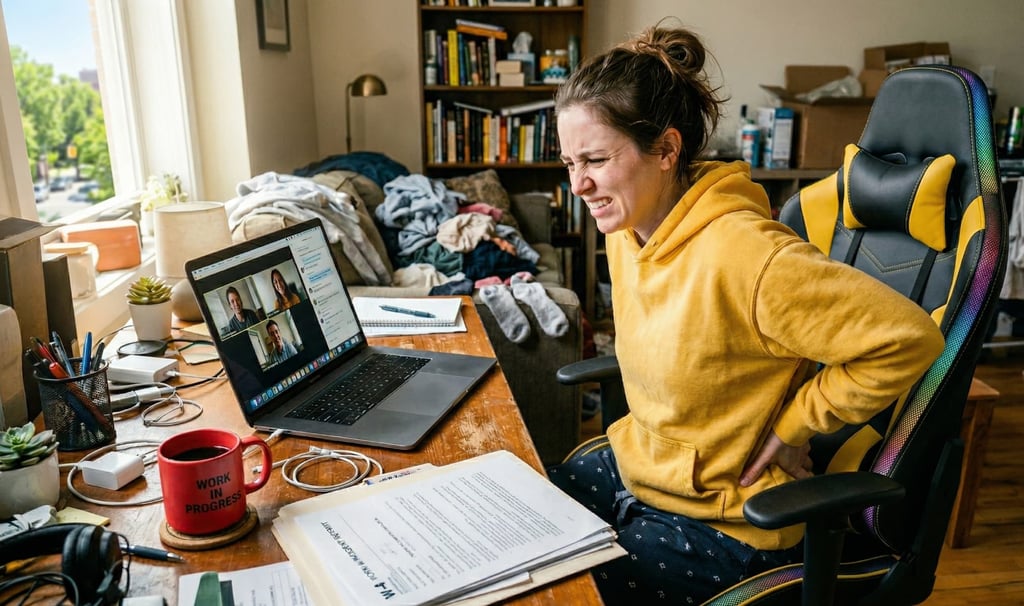
You work from home, answer Slack messages in sweatpants, take Zoom calls from the same room where your laundry is building a small republic, and open Google Docs with one hand and grab reheated coffee with the other.
So naturally, in your brain, workers’ comp sounds like one of those dusty office terms meant for forklift accidents, warehouse drama, and somebody named Gary slipping near a pallet jack. Not you, not your ergonomic-ish chair from the internet, and not your laptop balanced three inches from a houseplant and a dying charger.
But here’s the surprise: if you're doing paid work from home and you get hurt because of that work, workers’ compensation may absolutely matter to you. The tricky part is that once your home becomes your workplace, the question is no longer “Am I covered because I’m in my house?” The real question is, “What exactly was I doing when I got hurt?”
That's where remote workers get confused.
People imagine there must be one magical room in the house that counts as the office, and everything outside that room is just regular life. Real life is messier than that. Coverage usually doesn't depend on whether you were in the guest room, the kitchen, the porch, or the corner of your bedroom you aggressively call your workspace.
It depends more on whether you were doing something connected to your job. If you trip while carrying company equipment, reaching for files during the workday, or walking to grab something you need for work, that starts to sound job-related.
If you trip because your kid left a toy in the hallway while you were off doing normal home-life stuff, that starts sounding personal. Your entire house isn't automatically covered just because you opened a laptop there, but your protection doesn't vanish just because you stepped away from a desk either.
And yes, this gets weird fast, because remote work has destroyed the old clean line between “I'm officially at work now” and “I'm still just being a person in my house.” Does your workday start when you sit down at your desk? When you open your first email from bed? When you answer a quick message at 8:00 PM that turns into twenty-five minutes of unpaid chaos?
In practice, the answer is usually less about furniture and more about function. If you're actively doing your job, even in some informal or modern way, that can matter more than whether you were sitting upright in your designated productivity chair like a little corporate pilgrim.
Remote work has made the clock blurrier. So an injury during a late-night work text, an early-morning email check, or a long meeting that spills into personal space may raise exactly the same question: were you doing work, or were you doing life?
That same blur shows up in the tiny actions that fill a normal workday. In a traditional office, nobody acts shocked if you stand up during a meeting to get water, use the bathroom, or grab a snack because your blood sugar is falling through the floor during a two-hour call that should have been an email.
At home, workers suddenly worry that every basic human movement turns them back into private citizens. But bodies are still bodies, even on Wi-Fi. If you get hurt doing something reasonably tied to getting through the workday, that may not be treated the same as wandering off to handle purely personal business.
The law is often trying to separate ordinary work activity from ordinary home life, and that line isn't always neat. Welcome to remote work, where even walking to the kitchen can feel like a legal riddle.
Then there's the chair. The chair is always there, silently plotting. One of the least dramatic but most common remote-work problems isn't a big accident at all. It's the slow, miserable buildup of back pain, neck pain, wrist strain, and “why does my shoulder suddenly feel 97 years old?” energy.
And because no manager is standing beside you looking horrified at your setup, people start wondering whether this is just their problem now. If your home workstation is hurting you, responsibility can get muddy. You may be expected to report the problem, document it, and ask for help rather than quietly turning into a folded lawn chair over six months.
Some employers offer equipment, stipends, ergonomic support, or guidance. Some do the corporate version of shrugging in high definition. But the fact that the company isn't physically inside your home doesn't automatically mean it has zero responsibility when the work arrangement it approved is part of what caused the injury.
Things get even stranger when work pushes you outside the home. Your Wi-Fi dies, the power is unstable, and you need to finish something important, so now you're driving to a library or cafe because remote flexibility apparently means turning into your own IT department.
Is that drive covered if something happens? Maybe, maybe not, and this is exactly where remote work becomes a legal maze. Once you leave home to keep working, the argument becomes whether that travel was truly part of the job or just a personal choice about where to work.
The same goes for deciding to answer emails from the porch, take a laptop into the backyard, or move to a different spot in the house for a change of scenery. A different location doesn't automatically destroy coverage, but it can raise new questions about whether you were in an approved work setup, doing a work task, and facing a risk tied closely enough to the job.
And because the universe enjoys comedy, remote-work accidents often involve things no office safety manual was built for: dogs, kids, rugs, leaking ceilings, unstable shelves, rogue cords, and all the other little agents of chaos that come free with domestic life.
If your dog barrels into your legs while you're on a professional call, or your child creates a tiny disaster during a work task, the situation gets complicated fast. If a pipe bursts, destroys your work laptop, and hurts you at the same time, you may suddenly be dealing with two separate problems that feel like one: the injury itself and the damaged property.
One system may deal with your body, another may deal with the laptop, and another may decide the house problem is just a house problem. Remote workers hate this part because it feels deeply unfair, but the law loves sorting one messy event into multiple buckets and then acting like that's emotionally normal.
That's also why proving a work-from-home injury can feel so awkward. In a normal office, there might be a coworker, a camera, a supervisor, or at least somebody who heard you yell. At home, there's often nothing but your own account, a timestamp, a message thread, a calendar invite, a photo, maybe a medical record, and the deeply humbling realization that documentation has become your best friend.
This isn't glamorous, but it matters. When there are no witnesses, the details start carrying more weight: what time it happened, what task you were doing, what device you were using, whether you reported it quickly, whether the story is consistent, whether the injury lines up with the activity, and whether there's any proof that you were actually working. Remote work didn't eliminate the need to prove a claim, it just replaced office witnesses with digital breadcrumbs.
The deeper point is that remote workers keep asking the wrong version of the question. They ask, “Is my house covered?” But that makes it sound like workers’ comp is some invisible insurance blanket floating room to room behind you.
A better question is, “Was I engaged in work strongly enough that the injury can be seen as work-related?” That's what ties all of this together. Not the room, the couch, or the fact that you were technically home. What matters is the connection between the injury and the job.
So no, this doesn't mean every household disaster suddenly becomes a workplace claim because you happened to have Outlook open. The rug doesn't become an HR issue just because you answered one Teams message before dinner, the dog doesn't become a coworker because it appeared in the background of a client call, and the porch doesn't become a satellite office because you wanted sunlight and a little main-character energy.
But it also means home isn't some legal dead zone where worker protections disappear the second you log in from your kitchen table. In many cases, remote workers aren't outside the system. They're just inside a messier version of it.
Work didn't stop being work because it moved into your house, it just got harder to recognize. The office is no longer one building with fluorescent lights and stale break-room coffee. Now it's wherever your employer expects output, wherever your devices follow you, wherever your schedule leaks into the rest of your life, and wherever your body is absorbing the cost of all that convenience.
That's why workers’ comp matters more to remote employees than many of them realize.
Not because every accident will be covered and not because every injury is automatically the company’s fault. But because once work enters your home, the old fantasy that home and work are cleanly separate stops being legally reliable.
That's a rough thing to discover while you're icing your back, replacing a broken laptop, and trying to remember whether the fall happened while you were living your life or just doing your job in a place that no longer feels fully like either one.
Legal
No spam. Unsubscribe anytime.
Explore
Business insurance, simplified.
Contact
Join the Newsletter
© 2026 Elinaetly. All rights reserved.