
WHOOP vs. Bevel: The Fitness App Lawsuit Startups Are Watching
WHOOP says Bevel copied its app experience. Bevel says the claims target common health app features. Now the case is raising bigger questions about IP risk, startup growth, and insurance before a company goes viral.
PROFESSIONAL LIABILITY (E&O)CYBER INSURANCEGENERAL LIABILITY
11 min read
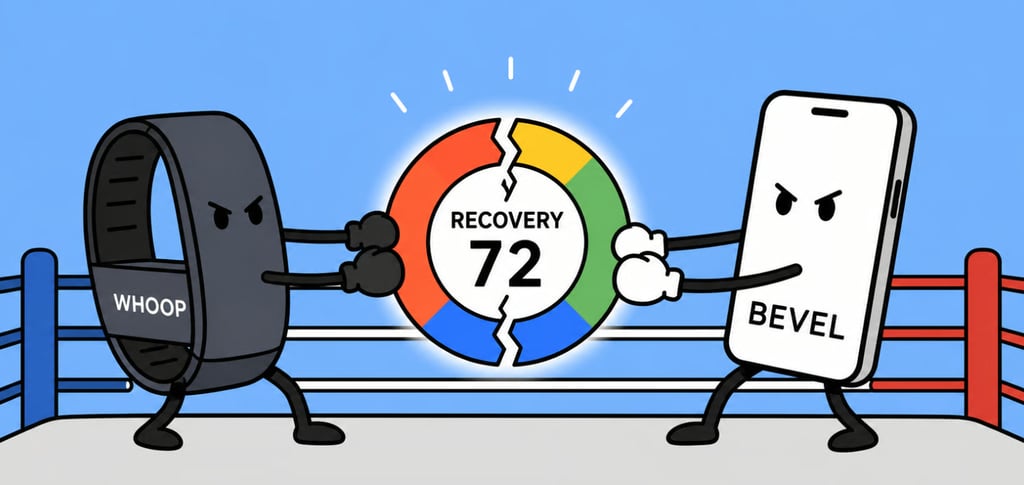
WHOOP is suing Bevel in a case that has become one of the most closely watched fights in the wearable health and fitness space. The lawsuit was filed by WHOOP, Inc. against Finerpoint, Inc., which does business as Bevel, in the U.S. District Court for the District of Delaware on March 17, 2026. The court docket lists the case as WHOOP, Inc. v. Finerpoint, Inc. doing business as Bevel, case number 1:26-cv-00289. The docket says WHOOP filed a complaint with a jury demand. It also lists the nature of the suit as a patent case and the cause of action as a Lanham Act trademark infringement claim, which can involve trademark, trade dress, false association, or unfair competition issues.
At the center of the dispute is a simple question with a complicated legal answer. WHOOP says Bevel copied important parts of its app experience. Bevel says it did not copy WHOOP, and that the things WHOOP is complaining about are common design choices used across many health and fitness apps. The case is not only about one company suing another. It also shows how valuable app design, user interface, health scores, and product identity have become in the fitness technology market.
WHOOP is best known for its wearable fitness band and subscription-based health platform. Its product tracks health and performance data such as strain, sleep, recovery, stress, heart rate, and other body signals. WHOOP sells a hardware and software experience together. Users wear the device, and the app turns their data into scores, charts, recommendations, and coaching-style insights. WHOOP describes its product as combining 24-hour health insights with personalized coaching to help users improve how they sleep, train, and feel.
Bevel is different. Bevel is a software-focused health app. It does not sell its own wearable band in the same way WHOOP does. Instead, Bevel is built around helping users understand health data from different sources. Bevel describes itself as a connected health coach that turns health data into personalized recommendations. In Bevel’s public response, Grey Nguyen, Co-Founder and CEO of Bevel, described the company as a smaller team focused on making health tracking more accessible.
That difference is important because it helps explain why the case matters beyond the courtroom. WHOOP has built a full hardware and subscription ecosystem. Bevel offers a health tracking layer that can sit on top of other devices and data sources. If a user can get a WHOOP-like set of insights without buying or wearing a WHOOP device, then Bevel becomes more than just another app. It becomes a potential challenge to WHOOP’s control over the full user experience.
WHOOP’s lawsuit accuses Bevel of copying parts of its design, user interface, and product experience. Based on the public docket and Bevel’s own description of the complaint, WHOOP is bringing a case that includes patent claims and Lanham Act claims. The Lanham Act side of the case is especially important because that is where claims connected to trademark, trade dress, and customer confusion often appear.
The legal claims appear to involve several forms of intellectual property. One is trade dress. Trade dress is a legal term for the look and feel of a product or service when that look and feel identifies the source of the product to customers. In plain English, WHOOP appears to be saying that parts of its app are distinctive enough that customers may connect those design choices with WHOOP. If another company uses a very similar design, WHOOP argues that customers could be confused.
Another part of the case involves copyright. In software disputes, copyright can involve code, visual design elements, screen layouts, or other expressive parts of a digital product. Bevel’s summary of the lawsuit says WHOOP claims Bevel’s user interface is substantially similar to the user interface created by WHOOP’s code. Bevel disputes that claim and says WHOOP’s comparisons do not show true copying.
The case also involves patents. Patents can protect inventions, including certain technical methods or systems used in software. Patent claims are often more technical than trade dress or copyright claims. In his public response, Grey Nguyen said Bevel would not fully address the patent issues because doing so could require discussing technical details of Bevel’s app.
Bevel’s side says the history of the dispute started long before the lawsuit. According to Bevel’s public statement, two WHOOP employees reached out in June 2024. Bevel says the message came from someone who worked in corporate development at WHOOP and expressed interest in learning more about Bevel’s vision, team, and goals. According to Bevel, WHOOP’s message described Bevel’s work as impressive and suggested there may be opportunities for collaboration between the two companies.
Bevel says it declined that conversation because the company was still young and did not have the resources to explore that kind of discussion. Then, according to Bevel, WHOOP sent a cease-and-desist letter about five months later. Bevel says that letter made many of the same claims that are now in the lawsuit. Bevel says it was surprised by the change in tone, because WHOOP had first appeared interested in a possible partnership and later became legally aggressive.
According to Nguyen’s public response, WHOOP demanded that Bevel disable dark mode and change names such as strain and recovery. Bevel says it pushed back because it believes those words are common, functional words in the health and fitness space. Bevel also says dark mode is common across many apps and is used by many people to reduce eye strain or limit blue light exposure. Bevel says its own app defaults to light mode, and that users must manually switch it to dark mode.
This is one of the major factual disputes in the case. WHOOP is pointing to similarities in how the apps look and work. Bevel is saying those similarities are either common in the industry, not accurate, or created by WHOOP’s own choice of screenshots. Bevel says WHOOP showed Bevel’s app in dark mode even though Bevel does not default to dark mode. If that is true, Bevel may argue that WHOOP’s comparisons make the apps look more similar than they normally would to many users.
WHOOP’s position, based on Bevel’s description of the complaint, is that Bevel’s home screen and other screens are confusingly and substantially similar to WHOOP’s app. Bevel says WHOOP points to features such as rings near the top of the screen, colorful circular bars that move clockwise, recovery and strain scores, coaching text in a rounded rectangle, and a dark gray or black background. Bevel’s answer is that rings, circular charts, color coding, rounded rectangles, and dark backgrounds are normal app design choices, especially in health tracking apps.
WHOOP also appears to be challenging parts of Bevel’s sleep pages. According to Bevel’s public response, WHOOP says both apps include colorful charts, bedtime and wake time labels, a crescent moon icon, sleep stage indicators, and typical range displays. Bevel says some of WHOOP’s descriptions are wrong. For example, Bevel says it does not use the same kind of colorful line graph WHOOP describes, and says it uses sleep stage charts and circular gauges in places where WHOOP says Bevel uses rectangles.
The sleep-page dispute matters because many health apps need to show the same basic types of information. Sleep apps often show when a person went to bed, when they woke up, how much time they spent in different sleep stages, and how those sleep stages compare with a normal range. WHOOP’s case appears to argue that Bevel’s total design is too close to WHOOP’s. Bevel’s response is that the building blocks are standard ways to show sleep data and should not be owned by one company.
Bevel also disputes WHOOP’s claim that Bevel changed certain parts of its app to look more like WHOOP. In the statement shared by Bevel, Nguyen says WHOOP claimed Bevel updated its home screen and journal feature in ways that made them similar to WHOOP. Bevel says the opposite happened. Bevel says its three-ring home screen layout already existed, and that WHOOP later updated its own app in a way that looked closer to Bevel’s layout. Bevel also says one of WHOOP’s examples was not actually Bevel’s journal page, but a settings view connected to the journal feature.
WHOOP has not framed the case as a simple complaint about common app design. Its legal theory appears to be that the full combination of design choices, names, charts, scores, and user flow creates a product experience that is too close to WHOOP’s. In trade dress cases, courts often look at the full impression created by the design, not just one element by itself. That means WHOOP may argue that even if rings, moon icons, rounded rectangles, or dark mode are common separately, Bevel’s total combination is too similar to WHOOP’s protected identity.
Bevel’s response is that WHOOP is trying to claim ownership over basic health app language and basic design patterns. Bevel says words like recovery and strain are functional. It says dark mode is common. It says rings and circular charts are common ways to display health data. It also says customers are not likely to confuse the two companies because WHOOP sells a wearable device and Bevel does not. In Bevel’s view, the companies have different products, different marketing, and different roles in the wearable ecosystem.
That customer confusion question is central to trade dress and unfair competition claims. If WHOOP can show that Bevel’s design makes customers think Bevel is WHOOP, connected to WHOOP, or approved by WHOOP, that could help WHOOP. If Bevel can show that customers understand the difference, that could help Bevel. Bevel says it has not seen customers confusing Bevel with WHOOP, and says its marketing makes clear that it is not selling a WHOOP-style hardware device.
The timing of the case has also drawn attention. WHOOP filed the lawsuit on March 17, 2026. Around the same period, WHOOP announced a large funding round and was valued at more than $10 billion. Bevel has pointed to WHOOP’s size and resources in its public response, describing WHOOP as a much larger company suing a much smaller team.
Bevel has suggested that the timing raises questions, but it has not claimed to know WHOOP’s true motive. In its public response, Nguyen framed the case as a large company using legal pressure against a much smaller team. That is Bevel’s framing. WHOOP’s public legal position, as reflected by the filing, is that the lawsuit is about protecting its intellectual property.
This dispute also fits a broader pattern seen across North America, especially in software, consumer technology, health technology, and direct-to-consumer products. When a product becomes popular, the most valuable thing is often not just the code or the hardware. It is the whole experience. That can include the app layout, the names of features, the colors, the way scores are shown, the dashboard, the onboarding flow, and the feeling users associate with the brand.
That pattern has created more fights over trade dress, user interface design, patents, and copyright. In older business disputes, companies often fought over logos, names, packaging, or physical product design. In newer technology disputes, companies can fight over screens, dashboards, icons, charts, and workflows. The WHOOP and Bevel case is an example of that shift because the arguments are not only about a wearable band. They are about the app experience that explains the data.
WHOOP has also been involved in other trade dress enforcement activity. In February 2026, WHOOP announced that a federal court granted a preliminary injunction against Shenzhen Lexqi Electronic Technology Co., Ltd. in a separate trade dress case involving a wearable health tracker. WHOOP said the injunction ordered Lexqi to halt U.S. sales while the litigation continued. That case was about hardware design, while the Bevel case focuses heavily on app design and digital experience. Still, both cases show WHOOP using intellectual property law to protect what it says are distinctive parts of its product identity.
Across North America, similar cases often follow the same rough path. A larger or more established company notices that a smaller company is gaining attention. The larger company sends a cease-and-desist letter. The smaller company either changes its product, negotiates, or refuses. If the parties do not settle, the larger company may file a lawsuit. The lawsuit may include several claims at once, such as trademark, trade dress, copyright, patent infringement, unfair competition, or false association.
These cases can be expensive even before there is a winner. A startup does not need to lose in court for the lawsuit to become a major business event. Legal fees, management distraction, uncertainty for investors, pressure from partners, and public attention can all affect the business. That is why the insurance angle matters, but it should be understood carefully.
For Bevel, the insurance question is whether it has coverage that can help pay for defense costs. Many startups buy general liability insurance, but general liability does not always cover intellectual property disputes in a broad way. Some general liability policies include personal and advertising injury coverage, which may help with some claims connected to advertising, copyright, trade dress, or certain trademark issues. But insurance professionals often warn that those policies can have major gaps for IP disputes, especially when patent claims are involved.
Specialized IP defense insurance is different. It is designed to help a company defend itself when it is accused of infringing someone else’s intellectual property. Defensive IP coverage can help with legal fees and other costs when a company is accused of infringement. Offensive IP coverage can help pay the cost of enforcing a company’s own IP rights against someone else.
That difference matters in this case because WHOOP and Bevel would likely have different insurance needs. Bevel, as the defendant, would care most about defense coverage. It would want to know whether any policy responds to trade dress, copyright, patent, unfair competition, or related claims. WHOOP, as the plaintiff, would care about enforcement coverage if it wanted insurance help to pay for the cost of bringing the lawsuit. Many ordinary policies are more likely to defend a company when it is sued than to fund a company’s lawsuit against someone else.
For WHOOP, the insurance question is also about brand protection and legal budget planning. A company with valuable intellectual property may choose to enforce it because it believes competitors are copying its product identity. But enforcement can be costly. If a company brings lawsuits regularly, it may look at specialized IP enforcement coverage, litigation funding, or a legal budget strategy. Insurance may not automatically pay for a company to sue, so companies often need to plan for enforcement costs separately.
For Bevel, the insurance question is more immediate. If a startup receives a cease-and-desist letter or lawsuit, it must quickly review its policies and notify carriers. This can include general liability, tech errors and omissions, media liability, cyber or technology package policies, directors and officers coverage, and specific IP insurance if the company bought it. Whether coverage applies depends on the policy language, the claims, the exclusions, the timing, and whether the insurer believes the allegations fall within the policy.
Insurance sources also point out that companies often look for coverage only after a lawsuit arrives. Specialty IP insurance is available, but not every company buys it early. Some companies try to seek coverage under the advertising injury section of a commercial general liability policy after an IP suit has already been filed. That can work in some situations, but it can also leave major gaps, especially where patent claims or intentional copying allegations are involved.
That pattern is common with startups. Early-stage companies often focus on growth, product, engineering, and fundraising. Insurance can feel like a back-office issue until a large claim appears. But as the WHOOP and Bevel case shows, the risk can come from the product itself. For a health app, the legal fight may not come from a slip-and-fall injury, a data breach, or a broken contract. It may come from the way the app shows recovery, sleep, strain, coaching, charts, and progress.
This is why IP insurance is becoming more relevant for software startups, AI companies, health apps, creator tools, consumer apps, and wearable technology companies. The more a product depends on interface design, branded workflows, and user experience, the more likely it is that intellectual property claims will become part of competition. That does not mean every similar app is infringing. It means fast-growing companies may face claims before a court decides who is right.
The WHOOP and Bevel case is still developing. WHOOP has made serious allegations, and Bevel has strongly denied them. WHOOP says Bevel copied protected parts of its app experience. Bevel says WHOOP is trying to control common health app patterns and basic words. WHOOP is asking the court to treat the similarities as legally meaningful. Bevel is asking the public, and likely the court, to see those similarities as normal, functional, or overstated.
For readers following the business side, the key fact is that the lawsuit is now part of the competitive story between the two companies. For readers following the insurance side, the case shows why intellectual property coverage can matter before a startup becomes widely known. A company may go viral because users like its design, but that same design can become the center of a legal fight. As the case moves forward, the next important developments will likely come from Bevel’s formal court response, any motions to dismiss or narrow the claims, and any court decisions about whether WHOOP’s trade dress, copyright, or patent claims can proceed. We’ll keep you posted on developments.
Image credit: Elinaetly
Legal
No spam. Unsubscribe anytime.
Explore
Business insurance, simplified.
Contact
Join the Newsletter
© 2026 Elinaetly. All rights reserved.