
When Big Companies Stop Competing, Everyone Else Pays
The Blue Cross Blue Shield story shows how quiet business rules can shape prices, choices, paychecks, medical care, and the hidden costs ordinary people feel for years
DIRECTORS & OFFICERS (D&O)
17 min read
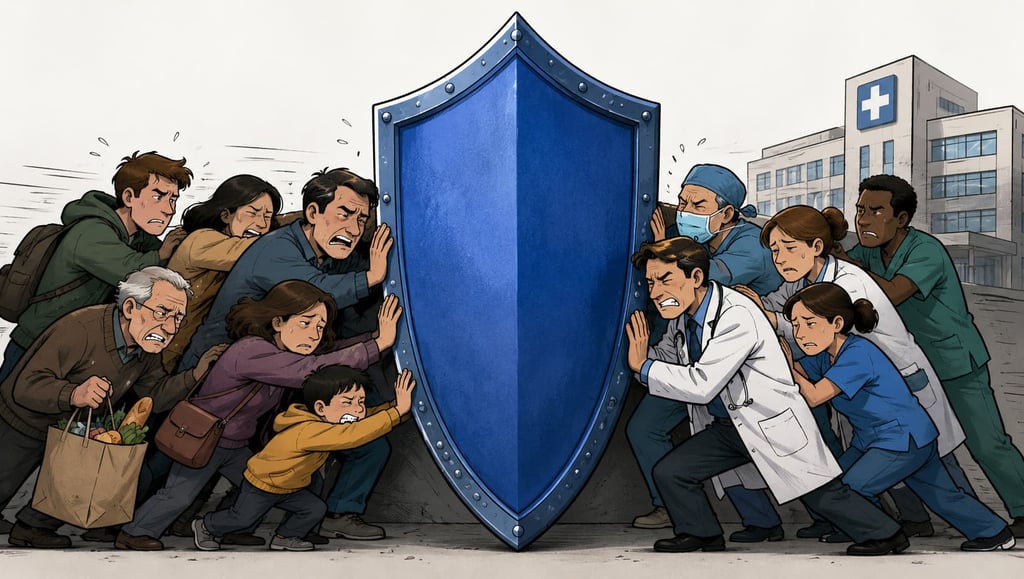
The Blue Cross Blue Shield lawsuit is one of those stories that sounds boring at first, until you realize it touches almost every part of normal American life.
Health insurance already makes most people tired. The words alone can make a person want to close the laptop, take a nap, and pretend the bill in the mail is just a decoration. Premiums, deductibles, networks, claims, copays, provider contracts, reimbursement rates, class actions, antitrust rules. It's enough to make a grown adult stare at a health insurance letter like it was written in ancient dinosaur language.
But this story matters because it's not just about one company, one bill, or one angry customer. It's about how a major health insurance system was accused of limiting competition for years, and how that may have affected customers, employers, doctors, hospitals, and medical groups across the country.
The simple version is this: Blue Cross Blue Shield and its member companies were accused of creating a system where different Blue companies stayed in their own territories instead of fully competing with each other. The customers and employers said that may have made health insurance more expensive and reduced choices. The doctors, hospitals, and other medical providers said the same system may have helped Blue Cross Blue Shield pay them less than they might have received in a more competitive market.
Blue Cross Blue Shield denied wrongdoing. The case ended in settlements, not a trial verdict saying Blue Cross Blue Shield was guilty. A settlement is often a business decision. Companies settle because trials are expensive, risky, long, and full of surprises. A courtroom can be like Thanksgiving dinner with legal briefs, you never know who is going to bring up something uncomfortable from ten years ago.
Still, the settlements were massive. One settlement for subscribers, customers, employers, and plan members was worth 2.67 billion dollars. Another separate settlement for medical providers was worth 2.8 billion dollars. That's not lunch money, that's not “Oops, we forgot to cancel a free trial” money. That's “the entire finance department is sweating through its shirt” money.
To understand the case, you first have to understand what Blue Cross Blue Shield actually is.
A lot of people think Blue Cross Blue Shield is one big normal company, that's understandable. The name sounds like one company, the logo looks connected, and the cards look similar. If you have a Blue Cross Blue Shield insurance card, you probably don't sit there wondering which local Blue plan is behind it while you're trying to figure out if urgent care is in network. You're just trying not to pay 400 dollars because your left ear decided to act weird.
But Blue Cross Blue Shield is really a system of separate member companies. These companies operate in different states and regions. For example, there is Blue Cross Blue Shield of Michigan, Blue Cross and Blue Shield of Alabama, Blue Cross and Blue Shield of Texas, Florida Blue, Horizon Blue Cross Blue Shield of New Jersey, Blue Cross Blue Shield of Massachusetts, and there are others too.
These member companies are connected through the Blue Cross Blue Shield Association, the association licenses the brand and sets certain rules for the companies that use the Blue name. That's where the legal issue became serious.
The people suing said the member companies weren't acting like normal competitors, they claimed the Blue companies had rules that divided the country into service areas. In very simple terms, the accusation was that one Blue company had its area, another Blue company had its area, and they weren't supposed to seriously compete in each other’s territory.
Imagine if every pizza place in town quietly agreed to stay on its own street. One pizza shop gets Main Street, another gets Oak Street, and another gets Maple Avenue. Nobody crosses over and nobody tries to steal customers from the other area. At first, that might sound neat and organized. But if you live on Main Street and the pizza is expensive, slow, and has the personality of wet cardboard, you can't easily get better competition from the pizza shop on Oak Street. You're stuck with Main Street pizza.
Now replace pizza with health insurance, and replace a few streets with large regions of the United States. Suddenly, the problem gets much bigger.
The subscriber group had one main complaint, they said customers and employers may have paid more because Blue Cross Blue Shield companies didn't fully compete against one another.
This group included individual customers, employers, insured groups, self-funded accounts, and employees covered under certain Blue Cross Blue Shield plans. These were people and organizations that bought commercial health insurance or used Blue Cross Blue Shield administrative services. Their claim wasn't just, “My bill was too high and I am mad.” It was more specific than that, they argued that competition was reduced because Blue companies allegedly divided markets and limited how they could compete.
In normal business, competition is supposed to put pressure on companies. If one company charges too much, another company can come in and offer a better deal. If one company gives bad service, another company can win customers by doing better. Competition isn't perfect, of course. Anyone who has compared health insurance plans knows it can feel like choosing between being poked in the left eye or the right eye. But competition is still supposed to give buyers more options.
The subscriber plaintiffs said Blue Cross Blue Shield’s rules limited that process. They claimed that if Blue companies had competed more freely, customers and employers might have had more choices and possibly lower prices.
Employers had a lot at stake here. Many Americans get health insurance through work. When health insurance gets more expensive, the employer feels it, the employee feels it, or both feel it. Sometimes the company pays more, employees pay more from their paycheck, deductibles rise, the plan gets worse, and sometimes everyone sits in an HR benefits meeting pretending to understand the new plan while secretly thinking, “So do I need to sell a kidney if I go to the emergency room or not?”
The subscriber was about the cost of health coverage in everyday life, employers trying to buy coverage, workers covered through those plans, and individuals buying insurance. The core accusation was that the market wasn't as open and competitive as it should have been.
The provider group had a different complaint, these weren't regular customers. These were doctors, hospitals, medical practices, physical therapists, psychologists, chiropractors, and other healthcare providers.
Their grievance was basically the other side of the same coin.
Customers said, “We may have paid too much.”
Providers said, “We may have been paid too little.”
The medical providers accused Blue Cross Blue Shield of using the same territory system to gain too much bargaining power. They said that if Blue companies weren't competing with each other, hospitals and doctors had fewer real options when negotiating contracts. That could push reimbursement rates lower.
If you go to a doctor, the doctor may bill the insurance company. The insurer then decides what amount is allowed under the contract and pays based on that. The patient may also pay a copay, deductible, or coinsurance. If this already sounds like a game designed by someone who hates normal people, you're not alone.
Providers argued that Blue Cross Blue Shield’s alleged market division made it harder for them to negotiate fair rates. If a hospital only had one major Blue plan in its area, and other Blue plans weren't really coming in to compete, the hospital might have less leverage. The same could apply to doctors and medical groups.
Think of it like selling your used car, but there's only one serious buyer in town, and all the other buyers have agreed not to come to your neighborhood. That one buyer can look at your car, kick the tire, sigh dramatically, and offer you less than you wanted. You can say no, but who else are you going to sell to? Your cousin who pays in coupons?
That's the kind of bargaining concern the providers were raising, except with hospitals, doctors, and medical services instead of used cars.
The provider settlement included many types of healthcare providers: Some were hospitals and healthcare systems, individual doctors, physical therapy groups, psychologists, chiropractors, and medical organizations. Their shared accusation was that Blue Cross Blue Shield’s structure reduced competition and helped suppress payments for medical services.
This is what makes the case so interesting from a business point of view. The same alleged system created two different types of harm, depending on who was looking at it.
Customers and employers said reduced competition could mean higher prices.
Doctors and hospitals said reduced competition could mean lower payments.
That sounds strange at first. How can one system make one group pay more and another group receive less? But in business, that can happen when one side has a lot of market power. A powerful middle player can sometimes collect more from buyers while paying less to suppliers. In healthcare, the insurer sits between the customer and the provider. So the insurer can face complaints from both sides.
That's the part every business should pay attention to.
This wasn't just a health insurance story, it was a business insurance story. It was a risk management story, a governance story, and it was also a lesson in how private business rules can become massive public problems.
Businesses love internal rules, every company has them. Some are useful, confusing, and some are clearly written by someone who has not spoken to another human being since 2008. But rules shape how a company behaves.
In the Blue Cross Blue Shield case, the accusation was that the rules helped member companies avoid competing with each other. If true, that isn't just a small paperwork issue. That's the kind of issue that can become an antitrust case.
Antitrust law is about protecting competition, it's not about punishing a company just for being big. Big companies are allowed to exist. A company can grow because it has good products, strong service, smart leadership, or a brand people trust. Being successful isn't illegal. If it were, every popular coffee chain would need a lawyer standing next to the espresso machine.
The problem starts when companies are accused of using agreements, market power, or business rules to unfairly reduce competition. That can include price fixing, market allocation, bid rigging, illegal monopolization, or agreements not to compete. Market allocation is especially important here. That means companies are accused of dividing customers, territories, or markets among themselves instead of fighting for business.
That's why the Blue Cross Blue Shield allegations were so serious, the claim wasn't just that insurance was expensive. The claim was that the system itself may have limited competition.
A lot of companies think insurance is a magic shield. They buy policies, pay premiums, save the documents somewhere nobody can find, and assume they are covered. Then a big lawsuit arrives and everyone suddenly becomes a part-time insurance scholar.
Business insurance can be very helpful, but it doesn't cover everything. It also depends heavily on the exact policy language. Insurance policies aren't written like friendly texts from your cousin. They're written in careful legal language, full of definitions, exclusions, conditions, limits, sublimits, retention amounts, and words that make your brain feel like it walked into a filing cabinet.
For antitrust cases, the insurance questions can get very complicated.
Some businesses may have Directors and Officers insurance. This can protect company leaders, board members, and sometimes the company itself when they're sued over management decisions. A major antitrust lawsuit can trigger questions about D&O coverage, especially if executives or board members are accused of allowing risky practices.
Some businesses may have Errors and Omissions insurance, also called E&O or professional liability insurance. This can protect against claims that the company made mistakes in providing professional services. But an antitrust claim isn't always treated like a normal professional mistake. If the accusation is that the company’s business model illegally reduced competition, the insurer may say the E&O policy doesn't apply.
Some companies may have antitrust coverage extensions, but even then, coverage can be limited. The policy may cover defense costs but not settlements, it may cover investigations but not fines. It may cover certain claims only until there's a final finding of wrongdoing. It may exclude restitution, disgorgement, penalties, or amounts the company is accused of wrongfully gaining.
This is the painful lesson. Insurance might help pay lawyers, but it may not pay the biggest part of the loss.
Legal defense costs alone can be huge. In a giant class action, lawyers don't come cheap. This isn't a small claims court situation where someone shows up with a folder, a parking receipt, and righteous anger. These are massive cases with expert witnesses, economic models, document discovery, appeals, settlement negotiations, notices, administrators, and years of legal work.
But the biggest financial pain often comes from settlements, judgments, business changes, and reputational damage. Insurance may not cover all of that.
For example, if a company is accused of collecting money it shouldn't have collected, the insurer may argue that returning that money isn't insurable. The insurer may say, “We don't cover you for giving back money you weren't supposed to have.” That can lead to a fight between the company and its insurer.
So a company can be sued by plaintiffs, watched by regulators, criticized by the public, and then have a separate fight with its own insurance company. That's when the conference room coffee starts tasting like regret.
The Blue Cross Blue Shield case shows that businesses need to understand their insurance before disaster happens. It's not enough to buy a policy and hope. Hope isn't a risk management strategy, hope is what you use when you check your bank account after a weekend trip.
Businesses should ask clear questions before a lawsuit appears. Does our D&O policy cover antitrust claims? Does it cover class actions? Does it cover defense costs? Does it cover government investigations? Does it cover settlements? Are antitrust claims excluded? Are unfair competition claims excluded? Are price fixing or market allocation claims excluded? Are fines and penalties excluded? Does the policy cover the company, the executives, the board, subsidiaries, affiliates, and related entities? What happens if customers and suppliers sue at the same time?
These questions may sound boring, but boring questions can save companies from exciting disasters.
Another major lesson is that the biggest risk may be hidden inside the business model itself.
Many businesses focus on obvious risks: A fire, cyberattack, slip and fall, bad product, or stolen laptop. These are real risks. But some of the most dangerous risks are built into how the company operates every day.
If a business depends on territory rules, exclusive markets, pricing coordination, non-compete arrangements, customer restrictions, supplier restrictions, or partner rules that limit competition, it needs legal review. Not after a lawsuit, before.
This applies far beyond health insurance.
A franchise system should be careful about rules that stop franchisees from competing in illegal ways.
A marketplace should be careful if it controls prices, sellers, buyers, or access in ways that could be seen as unfair.
A trade association should be careful when competitors meet and discuss pricing, territories, customers, or strategy.
A platform business should be careful if it uses its position to pressure suppliers or sellers.
A healthcare company should be careful with provider contracts, payer contracts, network access, and reimbursement practices.
A fintech company should be careful if it controls merchants, customers, fees, and access to payment systems.
A software company should be careful with partner rules that stop others from competing.
Even small businesses should care. A small company may not face a billion-dollar lawsuit, but the principle is the same. If your business practice only sounds good when nobody outside the company sees it, that's a problem.
A good test is simple. Would you be comfortable seeing the rule quoted in a lawsuit? Would you be comfortable seeing it on the front page of a newspaper? Would you be comfortable explaining it to a customer in plain English? If the answer is no, don't ignore that feeling. That little stomach drop is your internal compliance department trying to save your life.
The BCBS story also shows that one business practice can create lawsuits from multiple directions.
This is very important.
Many companies think of risk as one lane. If customers are happy, they assume everything is fine. But a company has many relationships. Customers, workers, suppliers, partners, vendors, contractors, investors, regulators, competitors, and the public can all become sources of risk.
In the BCBS case, customers and employers had one complaint. Providers had another. Both were connected to the same basic alleged system.
That is scary for businesses because it means a practice can look profitable from the inside while creating anger on both sides of the market. A company might charge customers more and pay suppliers less. That may look like strong margins for a while. But if people later argue that those margins came from reduced competition, the legal risk can become enormous.
Class actions make that risk even bigger.
A single person might not sue over a small overpayment, a single doctor might not sue over one lower reimbursement. But when millions of claims are combined, small amounts become giant numbers. That's how a problem that seems manageable becomes a billion-dollar case.
This is why class actions are powerful, they turn repeated small harms into one large legal fight. From a business perspective, that means repeated practices matter. A small issue repeated across years, states, customers, and contracts can become massive.
The story also teaches that business changes can be as important as money.
A settlement doesn't always mean the company just writes a check and moves on. Sometimes the company also has to change how it operates. That can affect future strategy, contracts, pricing, sales, partnerships, and market behavior.
For a company, that may be more painful than the payment. Money is one thing, changing the machine that makes the money is another.
Imagine a restaurant being told it has to pay a big settlement and also change its entire kitchen process, menu pricing, supplier contracts, and seating system. That's not just a bad day, that's a full business redesign with legal supervision.
The Blue Cross Blue Shield settlement included business practice changes related to competition. The lawsuit wasn't only about the past, it was also about how the system would work going forward.
For business leaders, the lesson is clear. Legal risk should be discussed before a model becomes too big to easily change. Once a company builds years of revenue around a practice, fixing it becomes harder, more expensive, and more painful.
This is where boards and executives come in.
A board shouldn't only ask, “Are we growing?” It should also ask, “How are we growing?” Growth that depends on risky market restrictions may create future problems. Revenue is good, but revenue with a lawsuit attached is less fun. That's like finding a free couch on the street and then discovering it comes with bees.
Executives should also avoid treating legal review as a box-checking exercise. Legal and compliance teams should have real power to question business practices. If the only answer to a legal concern is “But this makes us money,” that's not a strong answer. Many bad ideas make money until they don't.
The insurance team should also be involved, risk managers shouldn't be brought in only after the lawsuit arrives. They should understand the business model, contracts, market position, and potential antitrust exposure. Insurance should be matched to real risks, not fantasy risks.
For example, a company in a concentrated industry shouldn't review insurance the same way as a tiny local shop. A company that works with competitors through an association should be extra careful. A company that controls a network of providers, sellers, franchisees, or regional partners should be extra careful. A company that sets rules for who can sell where should be very careful.
The best time to fix unclear coverage is before there is a claim. After a claim, the insurer will read the policy with a microscope and the company will read the policy with panic. This isn't the ideal learning environment.
The moral for normal people is also important.
Most Americans don't think about market structure when they pay health insurance premiums, they just know the bill is high. They know the deductible is high, the doctor is somehow both in network and not in network depending on which floor of the building they stood on, and that the whole system can feel confusing and expensive.
This case shows that prices aren't only shaped by medical care. They can also be shaped by competition, contracts, networks, and business rules that regular people never see. The customer sees the premium, the employer sees the renewal rate, and the doctor sees the reimbursement schedule. But behind all of that, there may be market rules shaping the outcome.
Competition isn't just a word used by economists who own too many charts, if affects real life. It affects what people pay, what choices they have, what businesses can negotiate, and how much power one side has over another.
When competition is strong, companies have to work harder. They have to offer better prices, better service, better products, or better terms. When competition is weak, customers and suppliers can both feel trapped.
Of course, competition isn't magic. It doesn't fix everything. It won't make hospital bills suddenly read like a friendly grocery receipt. But without competition, the system can become even harder for ordinary people.
The BCBS case is also a reminder that big systems can operate for a long time before the public fully understands how they work, many people only hear about a case when settlement checks are coming. By then, the conduct being challenged may go back many years.
If a business structure affects millions of people, people should understand how it works. If companies are connected through brands, licenses, service areas, and rules, those rules aren't just paperwork. They can shape markets.
For businesses, the deepest lesson isn't “buy more insurance.” That's too simple. Insurance is important, but it's only one piece.
The deeper lesson is this: build a business you can defend in plain English.
If your company rule requires a 40-page legal memo to explain why it's not unfair, maybe slow down. If your pricing system makes customers feel trapped and suppliers feel squeezed, examine it. If your partners are also your competitors, be careful what you agree on. If your territory rules sound like everyone is promising not to compete, call an antitrust lawyer before the class action lawyers call you.
Business leaders should remember that legal risk often starts as normal internal language. “This is our territory.” “That's their customer.” “We don't compete there.” “They stay out of our market.” “We all follow the same rules.” Sometimes these phrases are harmless, sometimes they're not. Context matters. But if those words appear in emails, contracts, meeting notes, or strategy documents, they can become evidence later.
And evidence has a funny way of sounding worse when read out loud in court.
A sentence that sounded casual in a meeting can sound terrible when a lawyer reads it slowly to a judge, it's like hearing your own voice on a recording. Suddenly everything feels wrong.
The conclusion of the Blue Cross Blue Shield story isn't that every company with territories is bad, that every large business is guilty, and it's not that insurance is useless. That would be too simple.
The real conclusion is that competition, governance, and insurance are connected.
A company’s business model creates legal risk, legal risk creates insurance questions. Insurance limits create financial exposure, financial exposure can threaten the balance sheet. And when the company is large enough, the effects can reach customers, employers, doctors, hospitals, and entire communities.
The Blue Cross Blue Shield case should make businesses ask better questions:
Are our rules fair?
Are we competing properly?
Are our partners actually competitors?
Are we limiting customer choice?
Are we limiting supplier bargaining power?
Would our contracts look bad in court?
Would our insurance respond if this became a class action?
Would our board understand the risk?
Would we be comfortable explaining this to a normal person?
That last question may be the most powerful one.
If a business can't explain its practices in simple everyday English without sounding suspicious, that's a warning sign. The public doesn't live inside corporate legal language, customers don't care about clever structures, doctors and hospitals don't care about internal brand rules if they believe they're being underpaid, and employers don't care about market theories when premiums keep rising.
People care about fairness, choices, prices, and power.
That's why this case became so big.
At the center of the story is a very simple idea: When companies compete, people usually have more choices. When companies are accused of not competing, the cost can build quietly for years. And when that cost finally becomes a lawsuit, the bill can be enormous.
For businesses, the moral is simple enough to tape on the office wall.
Don't build a company around rules you would be afraid to defend.
Don't assume insurance will clean up every mess.
Don't wait until a lawsuit to understand your coverage.
Don't treat competition law like something only giant companies need to worry about.
And most of all, don't confuse “this is how we have always done it” with “this is safe.”
Many business disasters start with that sentence.
The Blue Cross Blue Shield settlements are a reminder that a business practice can look normal for years, then suddenly become the main character in a multibillion-dollar legal fight. And as every business owner knows, you generally don't want to become the main character in a legal story. Main characters in lawsuits don't get fun theme music, they get invoices.
So the real business insurance lesson isn't exciting, but it's valuable.
Check the rules, the contracts, competition risk, insurance, exclusions, what happens if customers sue, what happens if providers, suppliers, or partners sue, and check before there is a headline, before there's a settlement website, and before someone in accounting has to ask why the legal budget looks like it swallowed a small country.
That's the story here.
It's about health insurance, yes. It's about Blue Cross Blue Shield, yes. It's about customers and doctors and hospitals, yes. But more than that, it's about what happens when business rules, market power, and insurance limits all meet in one giant legal mess.
And the lesson is very simple.
A company can survive many things: competition, bad quarters, and tough negotiations. It can even survive public criticism.
But it may not survive pretending that hidden risk isn't risk just because everyone inside the building got used to it.
Image credit: Elinaetly
Legal
No spam. Unsubscribe anytime.
Explore
Business insurance, simplified.
Contact
Join the Newsletter
© 2026 Elinaetly. All rights reserved.