
Your Business Might Be One Driver Away From a Mess
It Only Takes One Person Behind the Wheel to Expose Gaps You Didn’t Know Were There
COMMERCIAL AUTO
6 min read
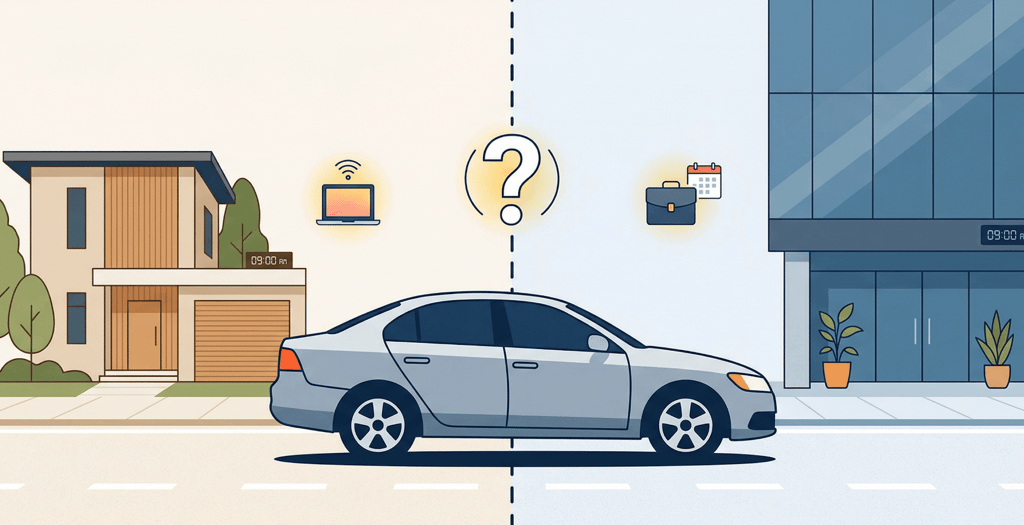
What makes work-related driving so tricky isn't just the risk of a crash.
It's the confusion that starts long before anything goes wrong. Most employees don't really know when they're officially driving for work, and most employers aren't much better.
In a traditional office setup, people used to assume the line was simple: your commute was your problem, and anything after that belonged to the company. But remote and hybrid work have wrecked that neat little boundary.
Now the workday might start in your kitchen, continue in your car, and end in a client parking lot while you answer emails you definitely shouldn't be reading at a red light. That means the first real question is no longer just whether someone was driving, but whether the trip itself was in the employer’s interest.
If you leave home for a client meeting, a company errand, a required off-site, a document drop-off, or some other task your employer expected or benefited from, the drive may be treated very differently from an ordinary commute. For remote workers especially, that distinction matters, because leaving your driveway doesn't automatically mean you're on a personal trip. In some cases, that driveway may be the edge of your workplace.
That's where the next problem shows up: people assume that if the trip is for work, the company’s insurance automatically wraps around them like a warm legal blanket. That's usually not how it works. If you're using your own car for company business, your personal auto insurance often comes first, because it covers the vehicle itself.
The employer may have additional coverage, such as hired and non-owned auto liability coverage, but that usually doesn't erase the role of your own insurer. It can come in after, fill gaps, or protect the company itself, depending on the policy.
Just because your boss told you to run the errand doesn't mean your personal insurer disappears from the story. That's why so many employees get blindsided after a crash. They thought they were using a personal car for a business purpose, but they didn't realize that business purpose and business coverage aren't the same thing.
And of course, because modern life can't resist being annoying, many trips aren't purely personal or purely professional. They're mixed. You head to a client visit, stop for lunch, swing by the dry cleaner, answer a work call, then continue on to a vendor. So now what? Are you covered, uncovered, half-covered, spiritually covered?
This is exactly the kind of gray area that creates fights between insurers, employers, and employees. A minor personal detour doesn't always erase the work connection, but it can complicate it. The more a trip looks like a personal frolic instead of a business task, the more room there is for someone to argue that the company should not be on the hook.
That's why businesses should never rely on unwritten assumptions about common sense. Common sense is wonderful until a claim adjuster, an attorney, and three different insurance policies all decide to have different common sense at the same time.
Things get even uglier when the employee causes the crash. A lot of workers assume that if they were doing something for the company, then the company will automatically shield them from everything. Sometimes there's protection, especially if the employee was acting within the scope of employment. But that doesn't mean the employee is magically immune from stress, scrutiny, or financial consequences.
Deductibles, policy limits, coverage disputes, and lawsuits can all enter the chat. If the company has the right coverage and the trip clearly fell within authorized work duties, that may help protect both the business and the employee. But if the company’s policies are sloppy, the trip wasn't clearly authorized, or the employee violated rules while driving, the story can change fast.
This is why businesses should stop treating vehicle use like some casual little side issue and start treating it with the same seriousness they give cybersecurity or data access. A company would never say, “Just log into whatever platform you want with whatever password feels right.” But when it comes to driving, many businesses are basically saying, “Use whatever car, do whatever errand, and good luck out there, champ.”
Remote work makes all of this even weirder. Imagine your home internet dies in the middle of the workday and you drive to a café to finish a report. Is that now work-authorized travel? Or is it a personal choice about where to work? That depends on the facts, and that uncertainty is exactly the problem.
In a digital workplace, travel is no longer limited to a central office or a standard route. People move between homes, coworking spaces, clients, airports, coffee shops, and temporary meeting spots all the time. The old assumptions about commuting don't fit cleanly anymore.
If the company expects you to be online, expects the work done, and knows employees use alternate locations when home systems fail, that trip may look more work-related than some employers want to admit. But if the company has no written guidance, the employee is left guessing, and guessing is a terrible risk-management strategy.
Vehicle condition raises another uncomfortable issue. Employees often think that if they're using their own car, maintenance is obviously their responsibility, end of story. Usually, yes, the owner of the vehicle is responsible for keeping it roadworthy. But liability can get much more complicated if the employer knew the vehicle was unsafe and still allowed or encouraged the employee to use it for work.
If a bald tire, bad brake, or known mechanical issue contributes to a crash, the condition of the car stops being background detail and becomes part of the legal narrative. Suddenly the question isn't just who was driving, but who knew what, who ignored what, and who should have stepped in sooner.
The digital age loves to pretend everything important happens in software, but physical risk still exists in brutally analog ways. A bad tire doesn't care that your company has an AI roadmap.
Then there's the personal insurance nightmare that employees almost never think about until it's too late. If you crash your own car while doing work for your employer, that claim may still hit your personal insurance history. That can affect premiums, underwriting, and future coverage options, even if the trip was work-related.
So employees shouldn't assume that simply writing client meeting on an expense report will protect their rates from going up. It may not. The only real protection is clarity before the trip happens: clear company policy, proper employer coverage, honest disclosure to insurers where required, and a real understanding of whether personal vehicle business use creates extra exposure.
Otherwise, the employee ends up in the worst possible position: helping the company get its work done while quietly taking private financial risk.
And when a crash does happen, the confusion becomes painfully immediate. In a remote or hybrid environment, there's no supervisor standing nearby saying, “Here's the incident form, the photos we need, and who to call.”
The employee is alone, stressed, possibly injured, and trying to remember whether HR wanted screenshots, timestamps, location data, witness details, damage photos, police information, or all of the above.
A smart company should already have a crash protocol for remote drivers that's simple and crystal clear: get medical help if needed, call emergency services when appropriate, document the scene, photograph vehicles and visible damage, save time and location data, identify witnesses, notify the company immediately, and avoid making casual statements about fault.
Without a protocol, even a manageable incident can spiral into a documentation mess. And today, when workers live inside apps, platforms, and digital records, there's really no excuse for employers not to have a clear mobile-friendly reporting system in place.
Even passengers can complicate the picture. Employees often assume it's harmless to have a coworker in the car, a child in the back seat, or some unofficial extra rider tagging along during a work errand. But unauthorized passengers can create all kinds of insurance and liability questions. A coworker may strengthen the argument that the trip was work-related, or it may create additional exposure for the company.
A child or other personal passenger may raise questions about whether the employee mixed personal and business use in a way that affects coverage. Some policies may not automatically void coverage just because another person was in the car, but that doesn't mean the passenger is irrelevant. Their presence can change how the trip is characterized, how damages are calculated, and how ugly the aftermath becomes.
The danger isn't only the accident, it's the giant pile of assumptions sitting underneath the accident.
Employees assume that if the task benefits the company, the company has them covered. Employers assume that if the employee owns the car, the risk belongs mostly to the employee. Managers assume that informal errands are too minor to require policy. Remote workers assume that if work happens everywhere, then work protection follows them everywhere too.
And then one crash reveals that everybody was building their confidence on vibes, guesswork, and crossed fingers.
That's why business driving has to be treated as a real commercial auto risk, especially in tech, startups, remote teams, and AI-driven workplaces that like to imagine they're too advanced to be tripped up by something as ordinary as a car.
The future of work may be digital, but liability exposure is still painfully physical.
One employee leaving home for a client meeting, one founder making a quick bank run, one remote manager driving to a café after the Wi-Fi dies, and one worker using a personal car to keep the business moving, that's all it takes to expose the gaps.
Legal
No spam. Unsubscribe anytime.
Explore
Business insurance, simplified.
Contact
Join the Newsletter
© 2026 Elinaetly. All rights reserved.