
A Customer Visits Your Business, Then Slips and Falls While Viewing One of Your Products
Does Sorry Cut It?
GENERAL LIABILITY
9 min read
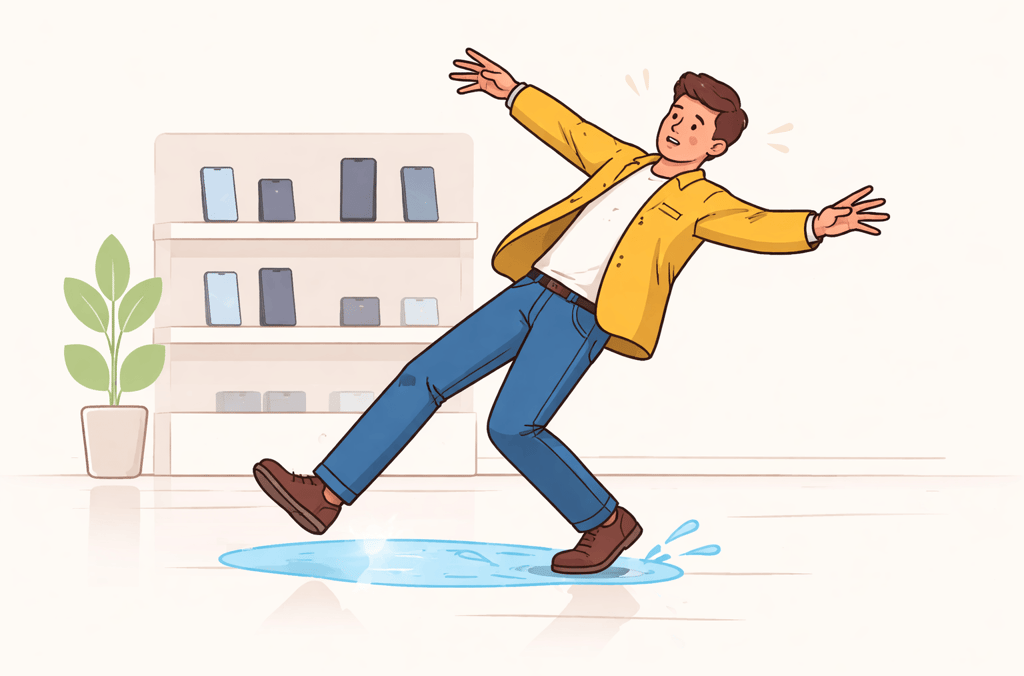
A customer walks into your business, looks around, and stops to check out one of your products.
Everything seems normal.
Then, in one quick moment, they slip and fall.
Now the whole mood changes.
What was supposed to be a regular visit suddenly becomes a serious business problem. At that point, saying “I’m so sorry” is the right human response, but it usually isn’t enough by itself.
If the customer is hurt, the situation can quickly turn into questions about medical bills, responsibility, documentation, and whether your business has the right protection in place.
That’s why this matters so much for modern businesses, especially now, when so many companies mix online work, remote work, home-based work, and in-person customer contact.
A lot of business owners still think accidents like this only happen in traditional stores. They picture a big retail location, a shopping center, or some old-school brick-and-mortar setup. But that’s not how business works anymore.
Today, a business might run from a home office, a shared workspace, a small studio, a hybrid office, or a showroom attached to a warehouse or even part of a house.
A company can be fully digital most of the week and still have customers stop by for demos, pickups, appointments, installations, consultations, or product previews. That’s the reality of the remote-work and digital-business world.
A business can be powered by cloud tools, AI assistants, ecommerce systems, and video calls, while still having real people step into a real space with real physical risks.
That’s what makes this issue easy to underestimate. A business owner may think, “We’re mostly online,” or “We don’t get that many visitors,” or “We’re a small operation.” But it only takes one customer visit and one accident to create a very real problem.
It could be a wet floor near the entrance on a rainy day. It could be a loose mat, a cord from a product display, a box left in a walkway, uneven flooring, poor lighting, or a tight space that was never really designed for visitors. None of those things sound dramatic at first.
They sound ordinary, that’s exactly why they’re dangerous. Many business risks don’t start with something huge, they start with small things that got ignored because everyone was busy.
And that’s where general liability insurance comes into the conversation.
General liability insurance is one of the basic forms of business insurance because it helps protect businesses when a third party, meaning someone who isn’t an employee, claims bodily injury or property damage connected to the business.
In a slip-and-fall situation involving a customer, this is often one of the first types of coverage people look at. It exists because accidents involving visitors are a normal business risk, not some weird once-in-a-lifetime event.
The idea is simple: if your business interacts with customers, clients, vendors, or visitors in physical spaces, even occasionally, there’s exposure.
This is especially relevant today because so many businesses are trying to create smooth, modern, flexible customer experiences. They offer local pickup, invite clients in for quick demos, let people visit by appointment, use shared offices, turn part of a home into a consultation space, and build small product areas in places that were originally meant to be private workspaces.
On paper, that all sounds efficient, modern, and convenient. In practice, it can also create gaps. The business may look polished online, but the physical setup may not be fully prepared for customer traffic.
A website can be clean, smart, and beautifully designed while the actual walkway to the product display is cluttered, narrow, or unsafe. Customers don’t separate the digital brand from the physical experience. To them, it’s all one business.
That’s a big point for tech businesses and remote-first businesses in particular.
Many founders and professionals are excellent at managing digital operations.
They think about software subscriptions, AI workflows, virtual assistants, customer response times, scheduling tools, data security, and online branding.
They’re used to solving problems with apps, automation, and systems. But physical safety still matters, even in highly digital businesses.
A customer can still trip over a charging cable connected to a smart display. They can still slip on a wet entryway while coming to see a device demo. They can still fall while walking through a home-based workspace that was set up for productivity, not visitor safety. The physical world hasn’t gone away just because work has become more digital.
The average American is already living in a mixed world where business happens everywhere. People work from home, shop online, pick up locally, attend pop-ups, visit shared spaces, and interact with businesses that blur the line between personal and commercial settings.
Professionals are already adapting to this, businesses are already adapting to this, and customers are already used to it. But adaptation shouldn’t stop at convenience and branding. It also has to include safety, insurance, and basic risk planning.
A modern business doesn’t just think about how to attract visitors. It also thinks about what happens when a visitor gets hurt.
When that happens, the first few moments matter. The customer may be embarrassed, upset, or in pain. The business owner or employee may feel shocked and want to immediately smooth everything over by apologizing and helping.
That human instinct makes sense. But from a business standpoint, the response needs to go beyond emotion. The person may need medical care. The scene may need to be documented.
The hazard may need to be removed or corrected right away, internal notes may need to be made, witnesses may need to be identified, photos may need to be taken, and the incident may need to be reported to the insurer. In other words, the business needs a process, not just a reaction.
This is one reason experienced businesses treat general liability insurance as a normal part of operating responsibly. It’s not something only large corporations need, it’s not just for traditional storefronts, and it’s not an optional add-on for later when we grow.
It’s one of the practical ways a business prepares for the fact that third-party accidents can happen. Credible insurance organizations and carriers consistently describe general liability insurance as core business protection because it addresses exactly these types of everyday risks.
That’s actually the positive part of the insurance story, the industry isn’t treating customer injury claims like some rare and unpredictable event. Instead, insurers treat them as a known exposure with known solutions. That means business owners don’t have to invent their own system from scratch, there’s already a structure for this.
One injury claim can be very stressful for a small company, not just financially but emotionally and operationally.
A large business may be better equipped to absorb disruption. A small operation may have fewer people, tighter cash flow, and less room for mistakes. Many small business owners are also still involved in every part of the business themselves.
They’re the founder, manager, scheduler, marketer, customer service team, and operations lead all at once. In that environment, one unexpected incident can take up a huge amount of attention. Insurance helps because it creates support around the claim process. It gives the business a better foundation for handling what comes next.
This becomes even more important in home-based businesses. A lot of people now run serious businesses from home, and many of them do it very professionally.
They may have online stores, consulting services, content studios, design businesses, product businesses, tech setups, or local service operations. Some meet customers in person, have pickups, do demos, or operate by appointment only.
It’s easy for an owner in that situation to think of the space as both home and business, switching mentally between the two. But from a risk perspective, once people are coming to the property for business reasons, the exposure changes.
The business side of the space matters. Walkways, entrances, floors, storage areas, displays, cords, steps, weather conditions, and layout all become more important than many owners realize.
In the current business world, this issue also connects to AI and automation in an interesting way. Many businesses are using AI to improve customer support, organize schedules, answer questions, write content, automate follow-ups, and manage internal knowledge.
That can save time and improve consistency. But AI doesn’t replace physical risk awareness. An automated booking system can make it easier for people to schedule visits, but it doesn’t make the space safe.
A chatbot can answer product questions in seconds, but it can’t stop a customer from slipping near the demo table. A smart business uses digital tools to improve operations, but it also remembers that real-world spaces need real-world care.
In fact, businesses that are serious about modern operations usually understand both sides. They use technology for efficiency, and they use procedures, maintenance, and insurance for protection.
That balance is what professionals are already doing. Businesses that take risk seriously don’t wait until after an accident to think about customer safety. They inspect spaces, pay attention to floors, mats, cords, lighting, weather exposure, and walkway design.
They think about where visitors will stand, where they will walk, and what might distract them while they are looking at products.
They review how product displays are arranged, separate storage from customer areas, train staff on what to do if someone gets hurt, document incidents carefully, report claims promptly, review what went wrong and make changes, and don’t treat safety as separate from business quality. They treat it as part of professionalism.
That’s also what many insurance sources encourage. The message from credible insurers is generally constructive, not negative. The focus isn’t just on claims after something happens. It’s also about prevention and preparedness.
Insurers often provide business owners with guidance on slips, trips, falls, housekeeping, hazard awareness, and general liability coverage because they know these are common risks.
That should be encouraging to business owners, not discouraging. It means there are practical ways to reduce risk, improve customer safety, and strengthen the business before a problem happens. Insurance, in that sense, isn’t just about bad outcomes. It’s also part of responsible planning.
And that planning matters because customers today expect more. The average American customer is already used to fast service, clean digital experiences, and easy interactions.
They book online, compare businesses quickly, leave reviews quickly, and expect businesses to be organized. If they visit in person, they expect the same level of care from the physical experience as from the online one.
A modern customer doesn’t think, “Well, their website was great, so it’s understandable that their floor was unsafe.”
They see it as one connected brand experience. If the business appears polished online but careless in person, trust can drop fast. That makes physical safety not just a liability issue, but a business reputation issue too.
This is why a slip-and-fall incident can feel bigger than it sounds.
It’s not just about one moment. It can raise questions about business standards, operations, attention to detail, and whether the company was prepared.
A customer who gets hurt may wonder whether the hazard was obvious, whether the business should have fixed it, whether others were put at risk too, and whether the company is taking the incident seriously. Even if the injury turns out to be minor, the event can still create stress, tension, and reputational damage.
A business that responds calmly, documents the facts, shows care, and has the right insurance protection is in a much stronger position than a business that is improvising in the moment.
That brings us back to the original question: does sorry cut it? The honest answer is no, not by itself. It matters to be kind, to respond with concern, and help the person and treat them with respect. But those things are only the beginning.
A business also needs a structured response. It needs good records, a safe environment, procedures, and appropriate insurance coverage in place before anything happens. The apology is part of the human side. General liability insurance is part of the business side. Both matter, but they do very different jobs.
What smart businesses understand now is that the most modern thing they can do isn’t just automate faster or market better, it’s to build a business that is strong both online and offline. That means thinking about the customer journey from the first click all the way to the front door and the product display.
It means understanding that a remote-first business can still have in-person liability, recognizing that a home-based business can still face customer injury claims, and accepting that even highly digital companies still operate in the physical world. The businesses that really understand this aren’t being dramatic. They’re being realistic.
And realism is what helps businesses last. The companies that stay steady are usually the ones that handle ordinary risks well, they don’t ignore the basics because they are distracted by trends, assume being small protects them, being digital protects them, or being nice protects them.
Instead, they put the right systems in place, review their spaces, understand their exposure, and carry the right coverage. They know what to do when something goes wrong. That’s what makes a business look prepared, trustworthy, and professional in today’s environment.
So if a customer visits your business, looks at your product, and then slips and falls, the moment matters more than most owners want to believe. It can happen in a traditional store, a hybrid office, a home-based business, a studio, a shared workspace, or a tech-driven product demo setup.
It can happen to a large company or a solo founder. It can happen in a business that’s mostly online but still has occasional in-person traffic. And when it happens, sorry isn’t enough on its own.
What matters is whether your business has treated customer safety as part of doing business, whether you've prepared for third-party injury risks, and whether general liability insurance is there to support the response.
That’s the real lesson for the digital age.
Modern businesses aren’t just websites, apps, AI tools, and remote teams.
They’re also spaces, walkways, entrances, displays, and real-world interactions.
The strongest businesses understand both sides. They know convenience, technology, and flexibility matter.
But safety, responsibility, and coverage matter too.
When all of those pieces work together, a business is in a much better position to protect its customers, protect its reputation, and protect itself.
Note: This content is for informational purposes only and doesn't constitute legal, insurance, or professional advice; coverage and requirements may vary by situation and provider.
Legal
No spam. Unsubscribe anytime.
Explore
Business insurance, simplified.
Contact
Join the Newsletter
© 2026 Elinaetly. All rights reserved.