Elon Just Took An L, Here's Why You Should Personally Care
This isn’t just billionaire courtroom drama. It’s a warning about AI, power, work, leadership, business risk, and why you can’t afford to treat AI like a toy anymore.
DIRECTORS & OFFICERS (D&O)CYBER INSURANCEPROFESSIONAL LIABILITY (E&O)
10 min read
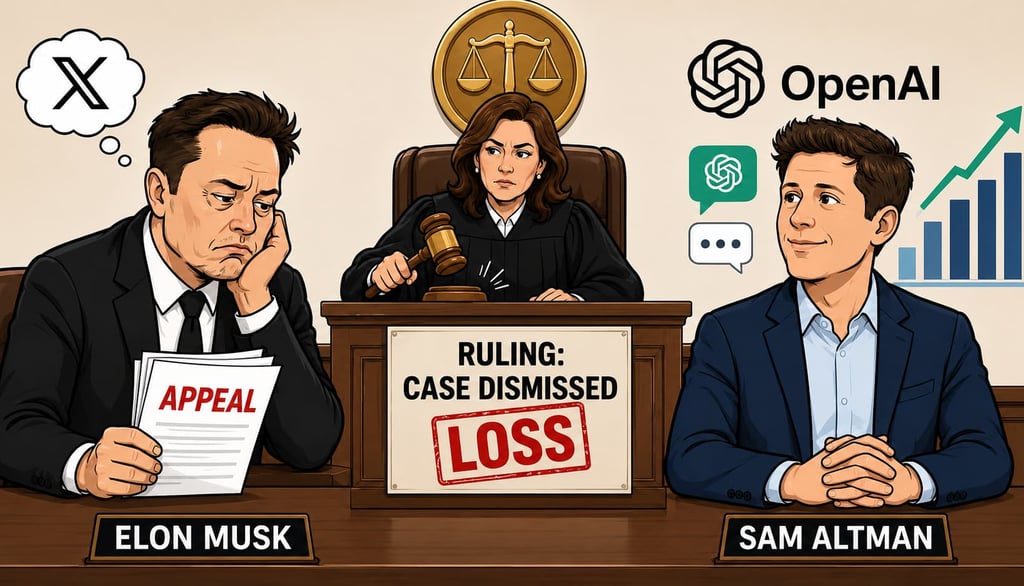
Elon Musk just took a very public L against OpenAI, Sam Altman, Greg Brockman, and Microsoft. A California jury rejected Musk’s claims that OpenAI broke its original promises by moving away from its nonprofit roots and building a much bigger commercial AI business. The jury found that Musk waited too long to bring the claims, and Judge Yvonne Gonzalez Rogers accepted that verdict as the final ruling. Musk has said he plans to appeal, so the fight may not be fully dead, but the first big courtroom round went OpenAI’s way.
And yes, this is the part where everyone online says, “Haha, Elon lost.” Fine. Laugh, post the meme, add the crying emoji, and make the joke. But after that, you should probably sit up a little straighter, because this case isn't just about Elon Musk, Sam Altman, and billionaire beef with better lighting than most Netflix shows.
This case is about who controls the AI tools that are slowly sneaking into every job, company, inbox, boardroom, sales process, support desk, coding workflow, legal draft, marketing plan, and every “Can you make this sound more professional?” message you’ve sent at 11:47 p.m. while questioning your life choices.
OpenAI didn’t just win a court fight. It won breathing room. It won more room to keep building, selling, partnering, raising money, serving customers, and pushing its products deeper into the working world. Lawsuits like this can hang over a company like a storm cloud at a wedding, nobody wants to invest in the wedding if Uncle Elon might flip the buffet table.
For OpenAI as a company, this win helps protect its current path. The company can keep acting like the center of the AI universe, which, depending on your mood, is either exciting or terrifying. ChatGPT is no longer just a fun toy people use to write poems about cats. It's now a work tool. It helps people write emails, analyze documents, build code, research markets, draft contracts, plan campaigns, summarize meetings, create training material, and think through decisions. In plain English, OpenAI isn't selling AI magic. It's selling work speed.
And when a company sells work speed, every other company has to ask a very uncomfortable question: “Are we falling behind?”
Your competitor isn't waiting for the court appeal to finish before using AI. They're already using AI to write proposals faster, to answer customers faster, clean up messy spreadsheets, turn calls into action items, find patterns in sales data, and create rough drafts before your team has even finished asking, “Who owns this?”
Meanwhile, some companies are still forming an “AI committee,” which is corporate language for “we're scared, confused, and would like to delay this until a consultant with a nice deck tells us what everyone already knows.”
OpenAI’s win gives its customers more confidence, at least for now. Customers want to know whether the tools they are building into their workflows will still be around, still be supported, still be improved, and still be legally usable. A huge legal loss for OpenAI could've created chaos. It could've scared customers, partners, developers, investors, and enterprise buyers. Instead, OpenAI walked away with a courtroom win, and that makes it easier for many customers to keep moving forward.
AI is becoming like email. You can hate it, complain about it, you can say it was better before. You can say, “I prefer doing things manually.” Cute. But the professional world doesn’t care about your nostalgia, it moves.
And when it moves, your job is to decide whether you’re using the tool, managing the tool, ignoring the tool, or being quietly replaced by someone who knows how to use the tool.
Companies like xAI, Anthropic, Google, Meta, Microsoft, and others are all fighting for trust, users, developers, enterprise contracts, government relationships, and the right to become the AI layer inside everyday work. Musk’s xAI is now a direct competitor to OpenAI, which made this case even more interesting. OpenAI argued that Musk’s lawsuit was tied to rivalry after he built his own AI company. OpenAI framed the lawsuit as coming from business competition, not just pure concern about OpenAI’s original mission.
This wasn't just a debate about truth, safety, and humanity. It was also a business war. The kind where everyone uses noble words while also protecting market share, talent, funding, control, and future power. That’s not shocking, that’s business. But it should make you ask better questions.
When a company says, “We're building AI for humanity,” ask, “Who gets paid?”
When a rival says, “They’re too powerful,” ask, “Would you be saying that if you were in charge?”
When a CEO says, “Trust us,” ask, “Cool, where’s the policy, the audit trail, the data protection plan, and the insurance coverage?”
AI creates new risk, legal risk, customer risk, data risk, copyright risk, privacy risk, reputation risk, board risk, employment risk, product risk, and professional liability risk. The kind of risk that sits quietly in the corner until something goes wrong, then jumps on the table like a raccoon in a restaurant.
Think about OpenAI. The lawsuit challenged its structure, mission, leadership, and commercial direction. That touches the kinds of issues companies cover through directors and officers insurance, often called D&O insurance. D&O insurance helps protect company leaders when they're sued over decisions they made while running the company. This case is a reminder that CEOs, founders, boards, and senior leaders don’t just make strategy choices. They make choices that can become lawsuits.
Now bring that down to normal companies.
If your company uses AI to make hiring decisions, who's responsible if the tool creates bias?
If your marketing team uses AI to create copy and accidentally copies someone else’s protected work, who pays?
If your support team uses AI and gives a customer wrong advice, who owns that mistake?
If your finance team uses AI to summarize a contract and misses one bad clause, who gets blamed?
If your employees put private customer data into a public AI tool, who has to explain that to customers, regulators, and the person in legal who already looks tired?
This is where business insurance becomes less like paperwork and more like a seatbelt. You don’t buy it because you plan to crash. You buy it because “we’re careful” isn't a risk management plan. It’s a prayer with a company logo.
Companies using AI should be asking about D&O insurance, errors and omissions insurance, cyber insurance, media liability, intellectual property coverage, employment practices liability, and technology professional liability. Not because every company needs every policy or because insurance is magic. It isn’t. Some policies exclude AI-related risks, some only cover certain kinds of claims, some require proper controls, and others will look at your AI usage and basically say, “Wow, you people are brave,” which is insurance language for “absolutely not.”
But the point is simple: If AI is part of your work, AI is part of your risk.
And if AI is part of your risk, your insurance conversations need to catch up.
The average professional should care because you're now part of the risk chain, whether your job title says AI or not. You don’t need to be a CEO to create a legal problem with AI, you just need to paste the wrong data into the wrong tool, send the wrong AI-generated answer to the wrong customer, rely on a summary you didn’t check, or use AI output like it came down from Mount Sinai wearing a blazer.
Don’t do that.
Use AI like a very fast intern who never sleeps, sometimes makes things up, and says everything with the confidence of a guy at a networking event who has not read the room. Helpful? Yes. Powerful? Absolutely. Safe without human review? Please be serious.
For Sam Altman personally, this win is massive. He didn’t just beat any plaintiff, he beat Elon Musk in one of the most watched AI business fights in the world. Altman has already survived major chaos, including OpenAI’s 2023 leadership crisis, when he was briefly pushed out and then brought back after employee and investor pressure.
For Altman, this win says, “I’m still here.”
That sounds simple, but in CEO world, staying power is currency. Investors want leaders who can survive attacks, employees want leaders who won’t disappear every time the building shakes, customers want leaders who can keep the product roadmap alive, and partners want leaders who won’t become a legal crater.
Altman’s win strengthens his position inside OpenAI. It gives him more room to say, “The court heard the case, and we won.” That doesn’t answer every ethical question about OpenAI. It doesn’t magically solve every concern about AI safety, copyright, labor disruption, data privacy, monopoly power, or whether these companies are moving faster than society can handle. But it gives Altman a powerful response to one major attack from one of the most powerful people on Earth.
Modern CEOs aren't just running companies, they're running trust machines. Their job is not only to grow revenue. Their job is to convince employees, customers, investors, regulators, partners, and the public that the company isn't about to explode in a very expensive way.
And when AI is involved, the trust machine needs extra oil.
Altman’s teams also benefit from the win. Imagine working at OpenAI while this lawsuit hangs over the company. Every big product decision, every customer meeting, every investor conversation, every press cycle has this legal fight breathing down its neck. A win gives teams more room to focus, engineers can build, sales teams can sell, product teams can ship, and legal teams can still suffer, because legal teams were born to suffer, but at least this specific cloud got lighter.
For OpenAI customers, the win means less uncertainty. If you’re building your company’s workflow around OpenAI tools, you don’t want to wake up and read that the company lost a case that could threaten its structure, leadership, or business model. Nobody wants their AI vendor to become a courtroom piñata.
But less uncertainty doesn't mean no uncertainty.
This is still AI, you should still ask hard questions before making OpenAI or any AI vendor central to your business. What happens to your data? What happens if the model gives bad output? Who checks it? What are your internal rules? Can employees upload customer information? Can contractors use it? Are you logging AI use? Are you reviewing outputs? Are you training people? Do you have approval steps for sensitive work? Do your client contracts allow AI use? Does your insurance cover the type of AI work you’re doing?
These aren't future questions, they're Monday morning before coffee questions.
AI is no longer a side experiment, it's the invisible co-worker in the room. It writes the first draft, summarizes the meeting, helps shape the pitch, answers the customer, reviews the code, suggests the strategy, creates the image, checks the spreadsheet, and whispers, “You can do this faster.”
And you can.
But faster mistakes are still mistakes, they just arrive wearing nicer formatting.
Musk's L is a sign that AI companies are serious business infrastructure, courts are getting involved, investors are watching, customers are committing, competitors are racing, regulators are circling, and insurance carriers are squinting at policy language like they just found a suspicious stain on a hotel bedspread.
You, the average professional, can't afford to treat AI like a toy anymore.
You should be using it, but you should be using it with rules.
Start building your own AI habits now, don’t paste sensitive data into tools without knowing your company’s policy, don’t send AI work without reviewing it, don’t let AI write legal, medical, financial, HR, or customer-facing decisions without human checks, and don’t pretend you understand a tool because you watched three LinkedIn posts and a guy named Brandon said “10x your workflow” next to a picture of a rocket.
Learn the basics, prompting, verification, what your company allows, what your clients expect, what your industry rules require, where AI helps you move faster and where it can get you fired faster.
For department leaders, the lesson is even sharper. You need an AI policy that people can actually understand, not a 19-page document nobody reads. What tools are allowed? What data is banned? What work needs review? What customer promises are being made? Who owns mistakes? Who approves new tools? Who talks to insurance? Who talks to legal? Who trains the team?
For CEOs, this case is a giant neon sign saying, “AI governance is now leadership work.” You can’t toss AI to the intern and hope for the best, you need board-level awareness, insurance reviews, vendor reviews, data rules, security checks, documentation, and you need to know where AI sits inside your company before it becomes the reason your company is sitting across from a lawyer.
For insurance brokers and carriers, this story is also a gift. It gives them a simple way to start serious AI risk conversations with clients. Don’t lead with boring policy jargon, lead with the obvious question: “Where are you using AI, and what happens if it goes wrong?”
That question alone can open the whole map.
Maybe the company uses AI for marketing. That raises copyright, advertising, and brand risk.
Maybe it uses AI for customer support, that raises errors and customer harm risk.
Maybe it uses AI for hiring, that raises employment and discrimination risk.
Maybe it uses AI for code, that raises security and product liability risk.
Maybe executives use AI to summarize board materials, that raises governance and confidentiality risk.
Maybe nobody knows what employees are doing. That raises every risk, plus comedy.
This is the part where someone says, “But we’re a small company.”
Great. Small companies can get sued too, leak data, lose clients, and make AI mistakes too. The lawsuit may be about billionaires and giant AI companies, but the lesson isn't only for billionaires and giant AI companies. Risk doesn't check your revenue before entering the room. It just walks in, eats your snacks, and asks whether you have documentation.
So yes, Elon Musk took an L. Sam Altman won. OpenAI got a major legal victory and Musk may appeal, the AI race continues, and the memes will be funny for about 48 hours.
But the bigger story is this: AI is now serious enough to fight over in court, serious enough to move markets, serious enough to shape careers, serious enough to affect insurance, and serious enough that every professional needs to stop acting like I’ll learn it later is a plan.
Later is how people lose ground, how companies fall behind, and how professionals become the person asking, “Wait, when did everyone start using this?”
The better move is simple: Use AI, question AI, check AI, protect your data, update your policies, review your insurance, train your team, ask better vendor questions, build better habits, and don’t panic, but don’t sleepwalk either.
Because the real lesson from Elon’s court loss isn’t just that OpenAI won.
The real lesson is that AI has moved from the group chat to the courtroom, from the demo to the boardroom, from the experiment to the insurance file, and from cool tool to business risk.
If that doesn’t make you care, just wait until your competitor uses AI to do in one afternoon what your team still schedules three meetings to discuss.
Image credit: Elinaetly
Legal
No spam. Unsubscribe anytime.
Explore
Business insurance, simplified.
Contact
Join the Newsletter
© 2026 Elinaetly. All rights reserved.