
You Accidentally Crack a Customer’s iPhone
Is Offering to Pay for a Repair Enough?
GENERAL LIABILITY
11 min read
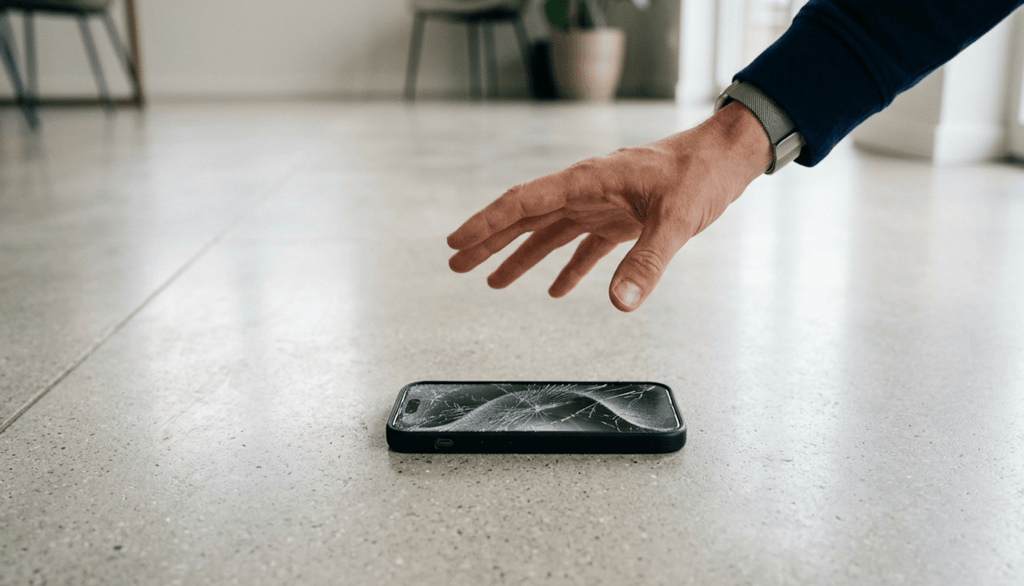

You know that split-second horror movie moment when your stomach drops before your brain even catches up?
Yeah, that.
You reach for a customer’s iPhone, it slips, hits the floor, and suddenly the screen looks like a spiderweb that got laid off in a tech downturn.
Everybody freezes.
The room gets quiet, even the Wi-Fi feels judgmental. And now the big question shows up wearing sunglasses and bad vibes: is offering to pay for a repair enough?
Usually, no.
It’s a good start.
It’s the human thing to do. It’s way better than pretending gravity is a liberal conspiracy. But in real business life, especially now, in the remote-work, always-online, “my phone is basically my wallet, office, therapist, bank, camera, boarding pass, and child” age, a cracked iPhone isn’t just a cracked iPhone.
It can turn into repair costs, replacement disputes, lost work time, lost access, angry texts, legal claims, and the kind of review that makes future customers back away slowly like they just saw a raccoon standing upright in daylight.
General liability insurance exists because businesses can be held responsible for third-party property damage and other claims, and the U.S. Small Business Administration says business insurance fills gaps that a business structure alone doesn’t.
In 2026, a phone isn’t just a phone unless the person still owns a fax machine and says things like “the cloud sounds suspicious.”
For a lot of customers, that iPhone is how they log into work, approve payments, talk to clients, get two-factor authentication codes, run deliveries, call their kids, use maps, store documents, and prove they are who they are.
Remote work made that even more true.
The Bureau of Labor Statistics reported that in April 2025, 20.8% of private wage and salary workers teleworked or worked at home for pay, which means a huge chunk of American work already happens through devices people carry around all day.
So when a business damages a customer’s phone, the damage can feel bigger than the glass.
It can feel like you dropped their whole day, their week, and maybe their blood pressure straight onto the tile.
That’s why “I’ll pay for the repair” sounds nice but often lands like bringing a Band-Aid to a kitchen fire.
What if the customer says the phone needs full replacement, not repair? What if Face ID stops working? What if the camera never looks right again? What if the customer misses work because the repair shop needs two days?
What if their case, screen protector, or AppleCare situation turns the whole thing into a mini courtroom in khakis? And what if the phone had business data on it and the customer claims your mistake caused lost income or a client problem?
Suddenly your simple, decent offer is standing in the middle of Times Square getting hit by taxis from every direction.
General liability insurance is designed to protect a business from financial loss if it’s liable for third-party bodily injury or property damage caused by its operations, services, or employees.
Multiple insurance sources say the same basic thing: if your business damages someone else’s property, this is the core category of coverage people look at first. The Insurance Information Institute describes general liability insurance as a foundational risk tool for non-professional negligent acts, and reputable carriers all describe general liability as protection for third-party property damage claims.
So is the answer just great, buy general liability and move on? Not so fast, champ. This is where business owners find out the insurance world loves footnotes the way software companies love surprise pricing tiers.
General liability is absolutely important, but it doesn’t mean every cracked customer device will magically be covered in every situation.
One big issue is the care, custody, or control exclusion.
That can mean if someone else’s property was in your possession or under your control when it got damaged, a standard general liability policy may not respond the way you hoped.
That’s the insurance version of finding out the free shipping had a 19-step emotional eligibility test. So yes, general liability is crucial, but no, you shouldn’t assume every “I was literally holding their phone when it broke” claim is automatically handled with confetti and a check.
That’s exactly why offering to pay out of pocket is often not enough from a business standpoint.
It’s not enough because you may underpay, overpay, or pay the wrong thing. It’s not enough because you may accidentally admit fault before you understand what happened, the customer may want more than the repair bill, and a one-person freelancer, a home-based consultant, a repair tech, a mobile notary, a photographer, a remote IT pro, or a field sales rep can all have slightly different risk setups.
One small my bad can become a much larger my lawyer says… And it’s definitely not enough if you’re running a real business and still handling risk with the same system you use to decide dinner.
The average American small business that takes risk seriously isn’t just crossing fingers and hoping the customer is chill. The U.S. Small Business Administration says general liability is a standard coverage type for any business, protecting against lawsuits, settlements, and judgments.
Insurers aimed at small businesses increasingly package coverage in ways that fit modern work: general liability for third-party injury and property damage, business owner’s policies for liability plus property, and professional liability for errors in services.
That’s especially relevant in tech, consulting, digital services, and remote work, where one problem can be physical, professional, or both at the same time.
Remote workers and home-based businesses are already in this insurance lane. Insurance providers insure self-employed individuals and IT consultants working from home, and most of their home-based business materials say a business owner’s policy can combine general liability with protection for equipment like computers, printers, copiers, and office furniture.
Others say general liability is the most common coverage for home businesses because it helps pay for third-party injuries and damages for which the business is responsible. That matters because the modern office might be a downtown suite, a spare bedroom, a kitchen island, or a backyard shed with suspiciously strong opinions about productivity.
The risk didn’t disappear when work moved home, it just put on sweatpants.
Let’s say you’re a consultant on Zoom all day from your house.
A client comes by once for setup, document signing, filming, a sales demo, equipment pickup, or a troubleshooting visit.
You knock over their phone.
Or maybe you’re a freelance tech pro doing onsite setup from a home base.
Or maybe you’re shipping devices around, touching client hardware, running hybrid meetings, or doing field visits between home-office sessions.
This isn’t some rare, random cowboy scenario anymore. It's regular modern business.
Professionals already buy coverage built around this kind of blended physical-digital risk because today’s business life is part office, part app, part living room, and part “sorry, you’re on mute.”
Should you offer to pay for the repair right away?
Yes, but carefully.
You should show empathy immediately. You shouldn’t act weird, defensive, or magically become a philosopher about material attachment. The customer is upset because their property got damaged.
That’s fair.
But the clean business move isn’t just blurting out, “I’ll cover whatever, don’t worry,” like you just won the lottery and have no accountant. The better move is something like this in normal human language: “I’m sorry, I understand this is serious. Let’s document what happened, get the repair estimate or device assessment, and I’ll handle this through the right business process.”
That keeps you kind without getting sloppy.
Why document it?
Because memory gets weird fast.
Everybody remembers events in high definition for the first ten seconds and then suddenly nobody agrees on anything.
Was the phone already cracked? Did it have a case? Did it fall from a desk, a couch, a standing tripod, a counter, or your hand? Did the customer hand it to you? Did you ask to inspect it? Did they place it near equipment? Were there liquids nearby? Was there visible prior damage? Were accessories affected? Did anything stop working besides the glass?
If this becomes an insurance claim, documentation isn’t a nice extra, it’s oxygen.
This is also where modern businesses look way more professional than businesses that operate like a group chat with a debit card.
A professional response usually includes an incident note, photos, the device model, date and time, names of people present, what work was being done, any estimate from a repair provider, and a clear internal escalation path.
If you have insurance, you notify the carrier or broker based on your policy and facts. That’s not overreacting, that’s basic risk management.
Most insurers have dedicated general liability claims resources, and say business insurance claims can be filed 24/7 online, by phone, or by mail. In other words, insurers are telling businesses: don’t freestyle a mess when there’s a claims process.
Even when the final dollar amount looks small, the business stakes can still be big. Maybe the screen repair is only a few hundred bucks.
Fine.
But what if the customer is a valuable account? What if they manage procurement for a company you want to keep? What if they were already unsure about your professionalism?
What if the whole interaction happens in a world where one annoyed customer can screenshot, post, review, tag, stitch, duet, and turn your bad afternoon into everybody else’s lunchtime content?
Welcome to the digital age, where reputation moves faster than invoices and a customer complaint can do cardio across five platforms before you finish your apology email.
That’s why good businesses usually don’t fight over the obvious stuff.
They move fast, communicate clearly, and make the customer feel taken seriously. That doesn’t mean rolling over and paying for fantasy losses because someone suddenly claims their cracked iPhone also destroyed their will to trust mankind.
It means separating the real, provable damage from the emotional thunderstorm and handling both like adults.
Insurance helps here because it turns a messy emotional event into a structured process. It brings in coverage language, claim handling, documentation, and, in many cases, defense or settlement support.
That’s not glamorous, it’s better.
Glamour is for launch parties, claims are for survival.
Businesses that prepare for these moments usually come out looking stronger. The business with general liability, a sensible business owner’s policy, a service workflow, and a grown-up incident process looks trustworthy.
The business that says, “We’re insured, here’s how we handle damage claims, here’s the next step,” sounds real.
It sounds established and sounds like a company that has seen Earth before.
That kind of professionalism can actually calm customers down, it tells them they aren’t trapped in a random side quest with somebody whose whole risk strategy was I’m usually careful.
A business owner’s policy is especially relevant for small businesses because it combines general liability and commercial property coverage in one package.
Insurers describe a business owner’s policy as a convenient, cost-effective way to protect both business assets and reputation, and most say they can cover liability issues plus damage to your own property or equipment.
Others say the same basic thing: a business owner’s policy packages liability and property coverage together.
For home-based, tech-heavy, remote-first businesses, that combo can make a lot of sense because your risk isn’t only what happens to customers; it’s also what happens to your gear, your workspace, and your ability to keep operating after a problem.
But if your business gives advice, builds systems, configures software, handles data, or provides digital services, there’s another layer.
A cracked iPhone might be the obvious problem, but service mistakes can create a second problem.
Insurers say technology professional liability insurance helps protect against errors, omissions, mistakes, or negligence in tech services or products, and they explain that professional liability can help with claims involving errors, omissions, negligence, misrepresentation, or inaccurate advice.
So for a modern tech or consulting business, the strongest setup is often not just one policy. It’s a stack that matches how the business actually works: general liability for physical third-party damage, business owner’s policy for property plus liability, and professional liability for service-related claims.
Today’s business accidents don’t stay in one category.
A physical incident can become a service complaint, a device issue can become a trust issue, a trust issue can become a contract issue, and a contract issue can become a why didn’t we have the right policy issue, which is always a deeply annoying meeting because those meetings come with hindsight, spreadsheets, and somebody saying “to be fair” right before making it worse.
Credible insurance sources aren’t saying, “Panic and hide under the desk.”
They’re saying coverage exists, claims processes exist, and small businesses can get insured fast. Most offer quick online quotes and that small businesses can bundle policies for savings.
They also say some contracts require liability insurance and that they provide certificates of insurance, which is a big clue about how normal this has become in the real market.
Professional buyers, corporate clients, landlords, and project partners often expect proof of coverage because everybody knows stuff happens. This isn’t a sign your business is cursed, it’s a sign your business is participating in Earth.
So what should you actually do if this nightmare iPhone scene happens?
First, stop the panic spiral.
Don’t get cute.
Don’t joke that “Apple will probably call that cosmetic.”
This isn’t the time to audition for Worst Person in Slack. Acknowledge the damage, apologize, and make the customer feel seen.
Second, document everything right away.
Third, don’t promise random numbers before you know the facts.
Fourth, review your policy or call your broker or carrier.
Fifth, decide whether this is a direct reimbursement situation, a claim, or both, based on the amount, your policy terms, and the exact facts.
Sixth, follow up quickly.
Silence is where customers start building monster stories in their head.
There are clear advantages to handling it this way, protect the relationship, lower the chance of a dispute, reduce the risk of paying the wrong amount, create a record, preserve insurance rights, look organized, and keep a bad moment from becoming a brand story about chaos.
You also protect cash flow, which matters a lot for freelancers, contractors, small agencies, and remote service businesses that can’t afford to treat every customer mishap like an all-you-can-eat buffet for unexpected expenses.
Claims can take time and coverage is never automatic.
Your policy language matters.
Deductibles, exclusions, and reporting rules matter.
A customer may still be annoyed even if you do everything right.
And if you have no coverage or the wrong coverage, you may end up paying out of pocket anyway.
That stings more when the device is expensive, the relationship matters, or the customer wants replacement instead of repair. But even then, a structured response still beats the “I Venmo’d them and prayed” method by a mile.
There’s one more truth worth saying out loud: your risk map is now weird, your front desk might be a Zoom link, your equipment might live in a condo, your clients might visit a coworking room, your home office, a coffee shop, or a temporary project site.
Your work product may be digital, but your risk is still physical, legal, reputational, and operational.
That’s why the smartest businesses don’t separate the real world and online world anymore.
They insure for both, plan for both, train for both, and they know one dropped phone can become a lesson in operations, customer experience, and business maturity.
That brings us back to the original question.
Is offering to pay for a repair enough?
As a human response, it’s a decent opening line.
As a business strategy, not even close.
It’s not enough by itself because the real issue isn’t just the repair.
The real issue is responsibility, documentation, customer trust, legal exposure, policy fit, and whether your business is built for the way people actually work now.
In a world where one device can hold someone’s paycheck, calendar, access codes, family photos, work apps, banking, and half their identity, “I’ll pay for the screen” can be like saying “I brought a napkin” after knocking over the wedding cake.
The good news is this problem is very fixable when you act like a real business.
Get the right liability coverage, consider a business owner’s policy if you have equipment and operating risk, and add professional liability if you provide advice or tech services.
Understand care, custody, or control before you assume a claim is covered, build a simple incident process, train your people, and move fast when something breaks.
Be kind, be clear, and let insurance do the boring hero work it was invented to do.
That’s what smart businesses are already doing.
That’s what credible insurance sources are already building products around.
And that’s how you turn an “oh no moment” into a "we handled it” story instead of a “guess who went viral for all the wrong reasons” story.
Heads up: This is general info, not legal or insurance advice. Your situation and coverage may vary.
Legal
No spam. Unsubscribe anytime.
Explore
Business insurance, simplified.
Contact
Join the Newsletter
© 2026 Elinaetly. All rights reserved.