
A Competitor Says One of Your Ads Is Defamatory
Do You Tell Them It Was Unintentional and Hope to Resolve It Amicably?
GENERAL LIABILITY
12 min read
You can tell them it was unintentional.
You probably should tell them that, actually.
But if your entire plan is basically, “Oops, our bad, let’s all be adults here.” That’s not a strategy.
When one ad can get screenshotted, reposted, clipped, quoted, AI-summarized, and passed around remote teams before your coffee gets cold, “we didn’t mean it” isn’t the magic spell some people think it is.
The risk isn’t just hurt feelings.
It’s legal costs, emergency internal reviews, evidence preservation, customer confusion, team panic, and leadership discovering that marketing moved faster than process.
Defamation generally requires a false statement presented as fact, communicated to someone else, with at least negligence and some reputational harm.
If the fight is really about ad claims, false advertising law can also get involved, especially when one business says another made misleading factual claims in commerce.
The first thing to get straight is this: not every mean ad is defamatory, not every spicy comparison is illegal, and not every angry letter from a competitor means you’re doomed.
U.S. law doesn’t ban comparative advertising just because it makes somebody mad.
The Federal Trade Commission has long said comparative advertising can help consumers and encourage product improvement, and it evaluates those ads under the same basic rule as other ads: are the claims false or deceptive, and do you have support for them?
Claims in ads need to be truthful, not misleading, and backed by evidence.
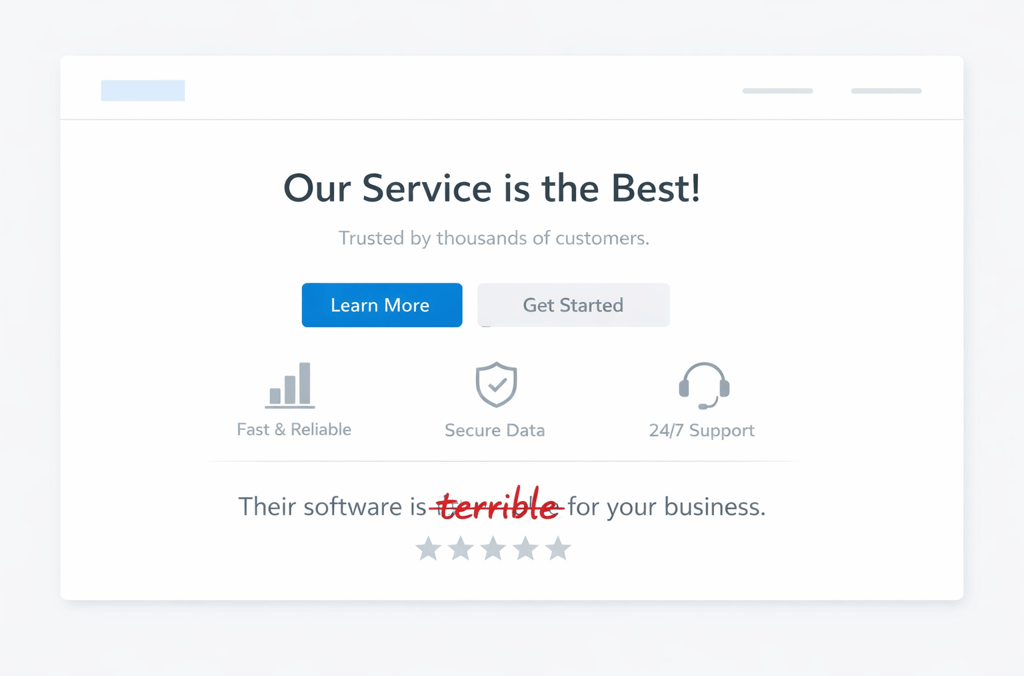
That means a sentence like “we’re faster” isn’t the same thing as “their software loses customer data every Friday and their support team communicates through smoke signals.”
One is the kind of marketing chest-thumping Americans see every day, the other is where the legal department starts typing like its keyboard owes it money.
So yes, tell them it was unintentional if that’s true. But don’t stop there, because intent isn’t the whole game.
In many defamation situations, negligence is a big factor.
You don’t always get a free pass just because nobody sat in a Google meeting rubbing their hands together and saying, “Let’s ruin Chad from our competitor.” If your team pushed out a factual-sounding claim without checking whether it was actually true, the problem can still be very real.
If the ad suggests verifiable facts about a competitor’s product, data security, business practices, pricing, compliance, or performance, then you’re not in “just kidding” territory.
You’re in “can we prove every part of this with documents, testing, and timestamps?” territory.
That’s a less fun territory, no one brings snacks there.
This is where a lot of tech and remote-work businesses get tripped up, because modern ad creation is basically an Olympic relay race of speed. One person drafts the copy from home.
Another person drops in a comparison chart from a shared drive.
Somebody asks an AI tool to “make this punchier.”
Another person trims the wording for a paid social post.
Then a manager glances at it between meetings while muted on video.
Suddenly a statement that started as “customers report fewer manual steps” becomes “their product is outdated, unsafe, and basically held together with duct tape and wishful thinking.”
A true masterpiece of distributed decision-making.
The Federal Trade Commission’s truth-in-advertising rules apply no matter where the ad appears, including online, and federal agencies have also been emphasizing preservation obligations for collaboration tools and ephemeral messaging in the modern workplace.
When a dispute starts, all those chats, edits, comments, and approvals stop being workflow and start being potential evidence.
That’s why the smart response isn't panic or denial.
It’s controlled, boring, and grown-up action.
This is where businesses that handle these situations well separate themselves from businesses that respond like someone accidentally posted from the brand account at 2 a.m.
The best move is usually to acknowledge the complaint, avoid admissions you haven’t vetted, pause wider distribution if needed, preserve the records, gather the substantiation, and get legal review fast.
“Unintentional” can help with tone and settlement, but it doesn’t replace fact-checking, documentation, or process.
Think of it like accidentally backing your car into somebody’s mailbox.
Telling them, “I swear I didn’t mean to” is better than yelling “your mailbox was asking for it,” but it doesn’t rebuild the mailbox by itself.
A competitor complains, and your internal reaction is often one of two things. Either: “They’re bluffing, ignore them.” Or: “Send flowers, shut everything down, maybe move to a cabin.” Both are bad.
Ignore it and you may make the damage bigger, especially if the ad keeps running, getting shared, or being repurposed into sales decks, email nurture sequences, landing pages, founder posts, and investor update slides.
Overreact and you may admit things too soon, confuse your team, and turn a containable issue into a five-alarm internal fire where every department starts improvising.
That’s how you get the remote-work version of chaos: legal says preserve documents, marketing edits three versions of the ad, sales keeps using the old slide in calls, an executive posts a clarifying thread, and somebody in customer success politely invents an explanation live on camera.
Absolute cinema.
What businesses in similar situations often do, especially disciplined ones in tech and business services, is treat the issue as both a legal-risk problem and an operations problem.
They lock down the content pipeline and ask a simple set of questions.
What exact statement is being challenged? Where did it appear? Is it still live anywhere? What proof did we rely on? Is the statement a provable fact, a comparison claim, a characterization, or puffery?
Did we quote internal data, third-party research, or anecdotal customer feedback? Who approved it? What downstream assets copied the same language? What screenshots, comments, tests, or model outputs exist?
This is also where businesses today are much more careful about AI.
AI tools can make language sound confident, polished, and researchy without giving you the legal safety net you think you’re getting.
A sentence that looks sharp on a landing page can still be unverified, an AI-generated comparison table can still smuggle in assumptions, and a rewritten social post can turn a nuanced performance claim into a hard factual assertion.
Once that gets published, the fact that a model helped draft it won’t make the dispute magically disappear.
The Federal Trade Commission’s position on advertising basics is still plain: claims must be truthful, not deceptive or unfair, and evidence-based.
A lot of average Americans already understand this dynamic instinctively, even outside business. They know the difference between saying, “I don’t love that restaurant” and posting, “That place gave everyone food poisoning,” when you don’t actually know that.
One is opinion, the other starts sounding like a factual claim that could blow up.
Same thing online, neighborhood groups, and business.
The law around defamation cares about false statements purporting to be fact, not just whether somebody felt attacked.
Courts don’t treat everything labeled opinion as automatically immune if the statement still implies provable facts underneath it.
So when a company tries to dodge responsibility by slapping opinion seasoning on a factual burger, that doesn’t always work.
“In our opinion, their app is fraudulent” isn’t the legal cheat code some people act like it is.
A lot of businesses are better prepared for this than they used to be.
They’re building review steps for comparative claims, requiring substantiation files before launch, training remote teams to separate opinion from fact in public-facing copy, keeping cleaner approval trails, preserving collaboration records better because regulators and litigants have made clear that modern workplace tools count, and treating insurance not as some dusty drawer full of boring paper, but as part of real operating discipline.
That’s not sexy, but neither is explaining to leadership why a throwaway ad line turned into a budget-crushing mess.
This is where general liability insurance enters the chat like the one responsible adult at a bachelor party.
General liability coverage is widely described as a foundational form of business protection, and it commonly includes coverage for personal and advertising injury, which can include things like defamation-related claims, at least subject to the policy’s terms, exclusions, and limits.
Industry sources describe general liability as protecting businesses from financial loss when they're liable for certain harms caused by operations, services, or employees, and they specifically include personal and advertising injury in that framework.
Liability coverage is also described as paying damages the insured is legally obligated to pay, up to policy limits and subject to policy terms.
That’s the boring sentence that can become the most beautiful sentence you’ve ever heard when a serious advertising dispute lands on your desk.
Coverage depends on the actual policy language and the actual allegations, some intentional acts may be excluded, some punitive damages may not be covered, and disputes over whether a claim fits the policy can be their own side quest from hell.
Insurance and regulatory sources discussing social-media-related defamation risk note that coverage questions can turn on how the claim is framed and whether the conduct looks intentional.
Businesses that buy the right general liability coverage, understand what personal and advertising injury means, notify carriers promptly when appropriate, and keep better records usually put themselves in a much stronger position than businesses that treat insurance as a yearly paperwork jump scare.
That’s why professionals handling this well usually do something very unromantic and very effective: they pull the policy, read the definitions, and notify the broker or carrier promptly if there’s a real claim or a credible threat.
Not six weeks later after twelve internal hot takes and one ill-advised friendly email.
Prompt notice is very important in insurance, so is accuracy, and not freelancing your own legal narrative in writing.
A competitor complaint can be smoke, or fire, or smoke with enough sparks to become fire if marketing keeps optimizing engagement while legal is still reading the ad for the first time.
So what should you actually do when the competitor says the ad is defamatory?
Freeze the urge to be clever.
This isn’t the time for a snarky response, a subtweet, or a “we stand by our bold messaging” post drafted by somebody who thinks conflict is a branding opportunity.
If the statement may be factual and unsupported, pause the ad and its clones while you review.
That includes paid placements, landing pages, social versions, PDFs, sales enablement decks, and any AI-generated variants that may have spread the same claim into a dozen channels.
In remote work environments, content multiplies like leftovers in the office fridge that no one admits are theirs.
You have to look everywhere.
Preserve your evidence.
Don’t clean up chats, tell people to delete drafts, or assume ephemeral messages are gone or should be.
Regulators have explicitly updated guidance to reinforce preservation obligations for collaboration tools and ephemeral messaging in modern workplaces.
Even outside a regulatory investigation, once a dispute becomes serious, deleting the messy stuff is one of those ideas that feels smart for eleven seconds and then becomes the reason outside counsel talks to you like you just microwaved aluminum foil.
Preserve the ad versions, substantiation, research, approvals, creative briefs, test results, vendor files, AI prompts if material, internal comments, and dates.
Separate tone from substance.
You can absolutely communicate in a calm, and non-combative way.
In fact, that’s often wise.
You can say you take the concern seriously and are reviewing the matter, you can say the company didn’t intend to make false statements, and you can say you value accurate advertising and fair competition.
All of that can help keep the temperature down.
But avoid blurting out admissions before you have the facts.
“We didn’t mean to defame you” isn’t the same as “we're sorry we published a false statement that harmed your reputation,” and your lawyers will very much care about that difference.
Subtle? Yes.
Important? Also yes.
Welcome to business, where one adverb can cost six figures.
Test the claim like an adult, not like a fan.
Ask what exactly in the ad is provably true, what’s provably false, and what's opinion or puffery.
If you claimed a competitor’s AI tool “hallucinates more often,” where’s the methodology? If you said their remote-work platform “creates security holes,” where’s the evidence and under what conditions?
If you suggested they “overcharge customers,” what was the benchmark and timeframe? If your proof is basically one customer quote, two screenshots, and Derek from growth saying “everybody knows this,” then congratulations, you haven’t collected substantiation.
Think about audiences and harm.
Defamation and false advertising fights aren’t just abstract legal puzzles.
They’re about what message reached whom and what it likely did.
Did current customers see it? Prospects? Investors? Analysts? Resellers? Procurement teams? Search engines? Was the ad geo-targeted, account-based, emailed, or posted on social? Was it amplified by employees working remotely on personal devices and personal accounts?
The broader and more factual-sounding the claim, the more the risk can grow.
Sometimes the biggest win is stopping the spread before the internet turns one bad sentence into everybody’s favorite screenshot.
Businesses do resolve these things amicably all the time.
A lot of disputes never become full public courtroom food fights. They get handled through revised copy, takedowns, clarifying statements, side letters, negotiated standstills, or quiet business resolutions.
Sometimes the competitor mainly wants the claim removed, sometimes they want assurances that it won’t reappear in a future campaign, and sometimes they want to preserve their rights and see whether you act like adults.
This is where a respectful tone actually helps because reasonable behavior can keep a bad moment from becoming a blood feud between two teams that still have to exist in the same market.
The funny part, in a darkly American way, is that the very companies most likely to preach “move fast” are often the ones who discover, too late, that truth moves at the speed of documentation.
You can launch an ad in thirty minutes.
You can’t build substantiation history in reverse quite so easily, turn we assumed into we tested, or convert sarcasm into a clean evidentiary record by adding a smiley face. The internet has taught people to treat language like a toy gun.
The meme-y tone of startup culture bleeds into sales copy, the joke from a team chat becomes the ad headline, the founder’s spicy conference panel line becomes website messaging, and the AI draft inherits the bravado of the prompt.
Everyone is half in marketing now, which means everybody is also half a risk factor now.
What are average Americans already doing that maps onto this?
They screenshot, save receipts, distrust wild claims, expect digital accountability, and know that saying something online by accident doesn’t magically make it disappear.
Professionals are doing the same, just with more software and higher invoices.
Businesses are building approval workflows, legal-review triggers, and stronger ad substantiation files because the cost of sloppy factual claims is too high in a world where every statement can be copied, preserved, and replayed.
Regulators are still focused on truthful, evidence-based advertising.
Insurance sources still describe general liability as a core protection for business risk, including personal and advertising injury.
The trend line isn’t “say whatever, fix it later.”
The trend line is “document it, support it, and be ready.”
There are clear advantages to telling the competitor it was unintentional and trying to resolve things amicably.
It lowers the emotional temperature, signals professionalism, reduces the chance that every email from here on out sounds like it was drafted by a flamethrower, preserves business relationships in a crowded market, buys time for a real review, and if the claim truly came from sloppy wording rather than malice, that tone can support a practical solution like editing or pulling the ad.
In many cases, that’s the smart opening move.
There are also disadvantages if that's all you do.
It can sound weak without being useful, imply more than you intend if phrased badly, delay the harder internal work of substantiation, preservation, and coverage review.
It can tempt executives to think the issue is handled because the email sounded polite and it can also backfire if the competitor isn’t looking for apologies but for removal, correction, and proof.
An amicable tone is a tool, not a plan. Saying “no offense” before offense doesn’t stop the offense.
The most effective path is the middle path: calm outside, and rigorous inside.
Externally, act like adults.
Internally, move fast in the least glamorous way possible.
Review the statement.
Pull the support.
Freeze the spread.
Preserve the evidence.
Assess legal exposure.
Check insurance.
Decide whether correction, clarification, or withdrawal is appropriate.
Train the team.
This is how good businesses turn an “oh no” moment into a manageable one, and sometimes even into a better operating model afterward.
The best result here isn’t merely avoiding disaster.
It’s emerging with stronger habits, better claim substantiation, AI governance for marketing, remote approval systems, content inventory tracking, policy awareness, coordination between legal, marketing, product, and sales, and understanding of what general liability insurance can and can’t do for advertising-related disputes.
Businesses that build those habits don’t just reduce one lawsuit risk.
They become more credible, more disciplined, and frankly less embarrassing.
In today’s digital business world, the companies that win aren’t the ones that never make mistakes. They’re the ones that don’t compound them with denial, improvisation, or fake confidence.
They’re the ones that understand that a funny line in an ad can become a very unfunny spreadsheet of costs if it crosses from opinion into unsupported factual attack, the ones that know “unintentional” is helpful but incomplete, that carry real coverage, read the terms, and use it as part of business resilience instead of an afterthought, and act before the screenshot becomes the case study.
So, do you tell the competitor it was unintentional and hope to resolve it amicably?
Yes, you can absolutely open that way if it’s true.
But hope isn’t the operating system, it’s the loading screen.
The real system is truth, proof, process, preservation, and coverage.
That’s what credible legal and insurance guidance points toward.
That’s what careful businesses are already doing.
That’s what gives you the best chance at a positive outcome: quicker containment, better negotiation posture, lower surprise costs, stronger internal controls, and a business that looks like it belongs in 2026 instead of a sitcom about people discovering email for the first time.
Be human, calm, specific, and fast in boring ways.
Don’t treat a defamation complaint like drama content, treat an apology like a substitute for a record, and assume your remote stack, your AI tools, or your general liability policy will save you automatically without good behavior attached.
Handle it right, and this can stay a correctable business problem.
Handle it wrong, and congratulations, your ad campaign just became a team-building exercise for lawyers.
Friendly reminder: This content is for informational purposes only and is not legal or insurance advice. Please consult a qualified professional for guidance specific to your situation.
Legal
No spam. Unsubscribe anytime.
Explore
Business insurance, simplified.
Contact
Join the Newsletter
© 2026 Elinaetly. All rights reserved.