
Burned Out, Stressed Out, and Checked Out
Can Worker’s Comp Help?
WORKERS’ COMPENSATION
6 min read
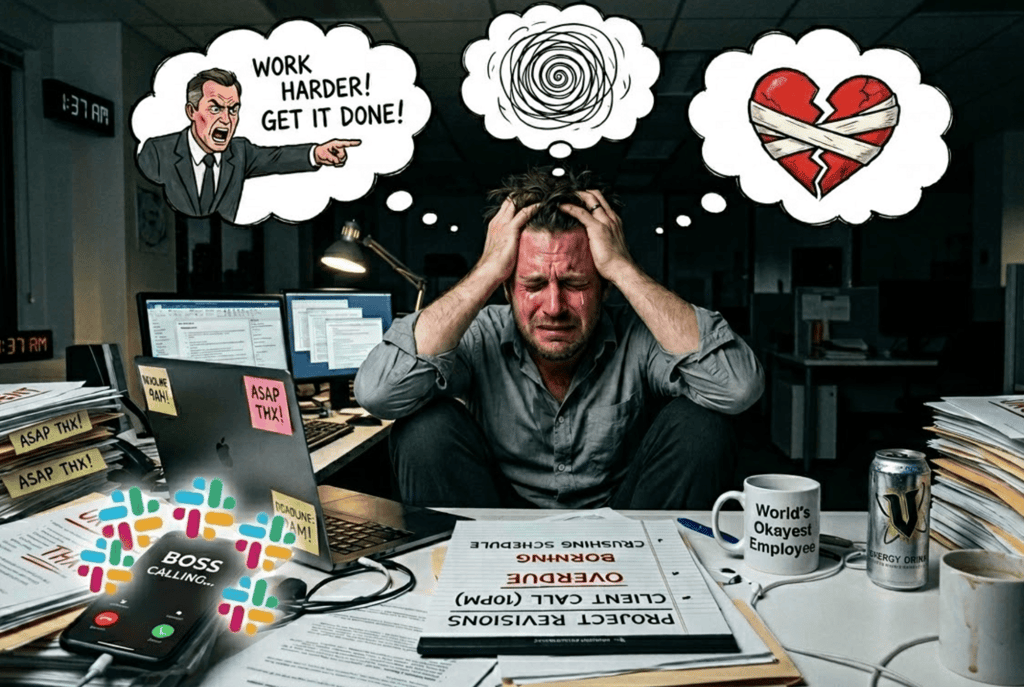
The biggest thing people get wrong about burnout and workers’ comp is thinking the system only cares if something dramatic and visible happens, like you fall down a stairwell, break a wrist, and end up in a sling that makes everybody in the office suddenly act supportive on Slack.
That's the clean, easy version people understand. Bone broken, claim filed, insurance pays something, everybody nods.
Mental health doesn't work that way, burnout doesn't show up on an X-ray, and stress doesn't walk into the room wearing a cast. So the question isn't usually whether mental-health-related harm is real enough.
The real question is whether the law in your state treats that kind of harm as a work-related injury, and if it does, how strong the connection to work has to be.
That's where people start panicking, because they assume there must be some magic waiting period. Like maybe you have to survive six miserable months before you're officially allowed to say, “Hey, I think this job is cooking my nervous system like a Hot Pocket.”
Usually, that's not the core issue. Workers’ comp is generally not built around some simple “you must work here for X months before your mind is eligible for suffering” rule. What matters more is whether you can show that your condition is tied to your work and whether you reported it within whatever deadlines apply in your state.
So if somebody is thinking, “I've only been here four months, so I guess my breakdown isn't yet premium content,” that's not usually how the analysis works. The timing that matters most is often when the problem started, when you realized it was serious, and when you told somebody.
Unlike in a movie, stress usually doesn't arrive from one source wearing a name tag. It comes from work, money, family, health, the news, your phone, your sleep, and whatever cursed little cocktail modern life has mixed for you this week.
So when stress comes from both work and personal life, people want a neat formula. They want the law to say something like, “If work caused 51% of your suffering, congratulations, you win a form.” Real life is uglier than that. In many cases, the issue is whether work was a major enough cause that the injury can genuinely be treated as work-related, not just part of your general human distress package.
So yes, if your life is already stressful and your job piles on top of it like a raccoon in a dumpster fire, that can matter. But the more your stress looks broad, mixed, and impossible to pin down, the harder it often becomes to turn it into a successful claim.
That's why physical symptoms can sometimes change the conversation. If burnout or stress starts showing up as constant migraines, panic attacks, insomnia, chest pain, high blood pressure, stomach issues, or some other condition a doctor can actually document, people often feel like they finally have something the system might take seriously.
And honestly, that instinct isn't crazy. A claim tied to a clear diagnosis, medical records, and visible effects on your ability to function can sometimes be easier to understand than just saying, “I'm mentally fried and every Slack ping feels like a home invasion.”
That doesn't mean physical symptoms are the only way stress becomes real. It means the more concrete, documented, and medically supported the condition becomes, the less room there is for people to wave it away as just ordinary annoyance, bad vibes, or part of the job.
Then there's the question everybody hates asking out loud: what if the stress is coming from your boss? Not the work in general, not the deadlines in theory. Your actual boss. The one who calls it high standards and performance culture while casually turning your endocrine system into soup.
In some cases, ordinary workplace conflict, criticism, bad reviews, or tough management aren't enough by themselves to turn stress into a compensable injury. The law often draws a line between normal personnel actions and something more extreme or harmful.
That means being managed badly, unfairly, or aggressively may feel devastating, but whether it qualifies can depend on how severe it was, how it was documented, and whether the stress came from the normal rough edges of employment or from something more serious and damaging. Very comforting, very clear, very definitely designed by people who've never received a “circle back on this ASAP” message at 9:47 PM.
Because mental injuries are harder to see, proof becomes everything. Nobody can point to your brain the way they can point to a cast. So if somebody is worried about what kind of evidence matters, the safest answer is: way more than you think.
Save the late-night emails, save the message threads showing you were expected to be always on, save the calendar that proves your schedule was absurd, save the records of 60-hour weeks, weekend work, impossible deadlines, and repeated after-hours demands.
If you ever complained, save that too. If your doctor told you your symptoms were tied to stress, save that. If your performance dropped only after the workload exploded, that timeline matters too. Digital work leaves digital footprints, and in a stress claim, those footprints may matter more than anything else. Your inbox may be ugly, but it may also be your witness.
That's especially true in remote and tech-heavy work, where the whole culture now acts like being permanently reachable is just professionalism with better branding. If your company expects you to answer texts at 11:00 PM, jump into emergency calls on weekends, and treat every notification like a fire alarm, that may absolutely become part of the story.
Not because one late text automatically creates a legal injury, but because a long pattern of after-hours pressure can help show the kind of environment you were working in. Burnout rarely comes from one dramatic event. More often it comes from thousands of smaller signals teaching your brain that rest is fake, boundaries are optional, and your job is allowed to sit at the edge of your bed refreshing itself like a software update from hell.
Of course, one reason people stay quiet is that they're terrified of what happens if they speak up. And that fear isn't irrational. A lot of workers worry that if they file a stress claim, the company won't openly retaliate in some cartoon-villain way. It'll do it politely, quietly, and professionally.
Suddenly you're not the right fit, you're left out of projects, and your boss gets very interested in culture alignment. That fear is one of the biggest reasons people delay reporting mental-health-related harm. The legal system may offer some protection against retaliation, but in real life people still worry about being branded difficult, unstable, or inconvenient.
So the silence makes sense, even when it makes the claim weaker later. That's the trap, the longer you stay quiet to protect your job, the easier it becomes for everyone to say the problem must not have been that serious.
And then there's the recovery question, which gets almost no attention because corporate culture still treats mental overload like a character flaw instead of a condition. People understand light duty when it means a bad knee or a hurt back. But when the injury is mental, people suddenly act like the only options are either fully fine or completely gone.
Real recovery isn't that neat. Someone might be able to work, but not at full intensity. They may need fewer meetings, less pressure, a more predictable schedule, smaller workloads, or a break from the exact conditions that caused the problem.
Whether that kind of reduced or modified work is available depends on the employer, the claim, the doctor, and the system involved. But the basic idea makes sense: sometimes the brain needs a version of light duty too, even if nobody has invented a glamorous brace for emotional collapse.
And finally, one of the most overlooked issues is what happens when physical and mental injuries start feeding each other.
Maybe someone is already out with a back injury, stuck at home, in pain, isolated, losing income, and slowly slipping into depression or anxiety on top of the original physical problem. At that point, the emotional harm may not feel separate at all. It feels like part of the same disaster.
And sometimes it's treated that way. If the mental-health condition developed because of the physical work injury and the fallout from it, therapy or psychological treatment may become part of the larger claim. That doesn't mean it is automatic. It means once a work injury knocks over the first domino, the system may have to deal with some of the dominoes that fall after it too.
So the cleanest way to understand all of this is this: workers’ comp isn't limited to obvious, dramatic injuries, but mental-health-related claims are usually harder, more fact-specific, and more dependent on proof.
There isn't always a waiting period, but there are often notice deadlines. There isn't always a precise percentage for how much stress must come from work, but work usually has to matter a lot. Physical symptoms can make a claim easier to understand, but they're not the only thing that counts.
A bad boss doesn't automatically destroy a claim, but ordinary management conflict may not be enough by itself either. Digital evidence matters, after-hours pressure matters, and retaliation fears are real. Modified work may still be possible. And when a physical injury leads to mental suffering, the system may sometimes follow that connection too.
In other words, the question isn't just, “Am I stressed?” Half of America is stressed.
The harder and more legally important question is, “Has my work caused a real, documented injury to my mind, my body, or both, and can I prove it?”
That's where burnout stops being a meme, a mood, or a personality trait and starts becoming something the system may actually have to reckon with.
Legal
No spam. Unsubscribe anytime.
Explore
Business insurance, simplified.
Contact
Join the Newsletter
© 2026 Elinaetly. All rights reserved.